Showing posts with label Federal Reserve Bank. Show all posts

Wednesday, August 26, 2020

Bulls and Bears


Had a conversation with a stock-savvy classmate on Monday. Asked him if he thought our stock markets were hitting record highs because the Wall Street pros thought Trump would win in November? His response was that it was more likely due to the enormous liquidity being pumped into our economy by the Federal Reserve Bank because of Covid. (Money has to be put to work somewhere.)

This is certainly likely ... since we saw this same stock market rise during the Obama administration due to about $10 trillion of liquidity injected during the Fed’s three phases of Quantitative Easing  ... combined with essentially zero interest rates.

Now that we effectively have zero interest rates back again, this is another inflator of stock prices. The prevailing interest rate is what one uses to discount the future corporate earnings stream to establish its stock price ... and forever zero rates thoeortically justify infinite stock prices. Calm down pilgrim ... it’s just theoretically ... we’re living in the real world ... and nothing is forever.

But, somehow I have to believe that if it becomes obvious  the Biden/Harris ticket will be clear winners (and the fake Indian as Treasury Secretary), we would not be hitting new stock market  highs ... more liquidity or not.


STAND UP FOR AMERICA!

Saturday, March 07, 2020

Why No Inflation?


I think I finally figured it out ... why we have had no inflation after years of our Fed (and other national banks) flooding the world with cheap money ... remember Quantitive Easing? Starting with the financial crisis in 2008, the Federal ReserveBank has been burning up the presses printing money ... as have the central banks in the European Union, Japan and most of the rest of the world. So why don’t we need wheelbarrows full of worthless bills to buy a loaf of bread ... like in Germany after World War One?

Well the coronavirus has exposed the reason. During our present pandemic we discover that over 90% of our critical drug components are made in China. And this seems just the beginning. For decades, ever since Bill Clinton invited China into the World Trade Organization, American companies have been shipping our manufacturing jobs to China ... because it was very cheap and provided results. Add to drug manufacturing transfers  ... electronics, toys, clothing, auto parts, furniture and on and on ... all at a mere fraction the cost of what it was here in the U.S.

This obviously has meant a continued large reductions in the cost of goods for American companies ... and fueled 7+% growth for China for almost 25 years ... a seismic economic shift happening right before our eyes ... yet we did not grasp the downside consequences.  Lower cost of goods has encouraged these American companies to keep prices low in order to expand market share (read Walmart, etc.). The United States has been on a consumer buying binge ... all fueled by hundreds of millions of very cheap Chinese workers (and the resulting strategic supply-chain fix we now find ourselves in due to the Wuhan virus.) We have built up a potential enemy in exchange for cheap manufacturing .... and more profits ... a massive strategic blunder given China’s desire to dominate. There is always an obverse side to every shiny coin.

Bingo ... no inflation ... despite enormous monetary expansion during the Obama administration. Now it all makes sense.

Afterthought: Will fixing our trade imbalances with China finally bring about the inflation we all have been expecting?

Sunday, November 17, 2019

The Big Unwind


When in 2014 the Federal Reserve Bank’s Chairman Janet Yellen stopped Ben Bernanke’s  three rounds of Quantitive Easings that had held the Obama economy’s lhead above water ... and had expanded the Fed’s balance sheet by 3.6 trillion dollars, we were assured by Bernanke that this excess liquidity in its balance sheet could be unwound without any consequence ... see: Bernanke Plan.

Unfortunately, he was dead wrong. When this process was eventually started and before the Fed had reduced its balance sheet by $500 billion (mostly under Trump), it has had to reverse itself and pump about this same amount of liquidity back into the economy ... due to soaring repo rates.

So much for an august Princeton economics professor’s understanding of economics!

Wednesday, October 23, 2019

A Federal Case


The US Federal Reserve Bank has had to inject massive amounts of funds into the banking system recently as shortages have caused overnight interbank lending (repo) rates to spike over 7% whereas normally these rates hover around 1.9% ... see: CNBC Story. Many economists are scratching their heads as to why this drying up of liquidity has occurred. I have a thought ... bear with me.

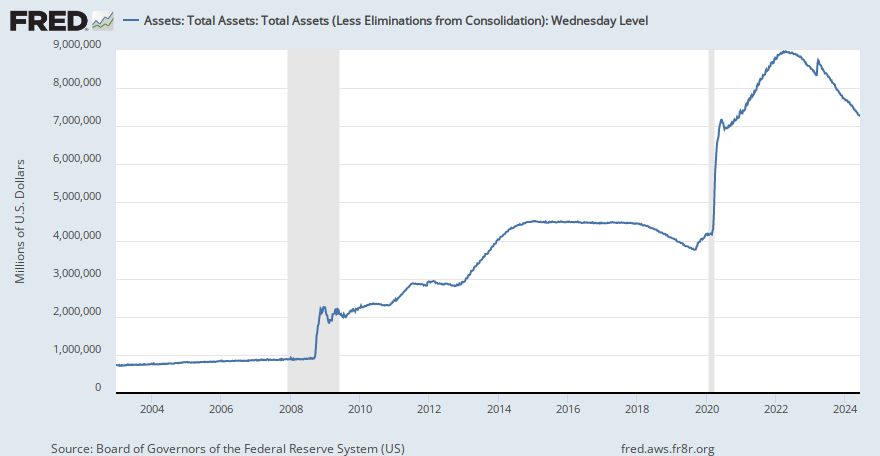
Now, I’m not an economist nor do I play one on this blog ... but I think I might have an idea what is going wrong. Over the last many months the Fed had reduced its balance sheet by over $600 billion (see chart) ... that had been bloated during the repeated “quantitative easings” employed during the Obama administration to hold our economy’s head above water.

The then-Fed chairman, Ben Bernanke expanded the Fed’s balance sheet by $3.6 trillion to $4.5 trillion (again see chart) by buying government bonds and mortgages ... see: Investopedia Entry This basically means that this same amount of readily-available money (M1) had been injected into the banking system ... resulting in pushing up asset prices and slightly stimulating the economy.

Enter stage right in 2017 President Trump ... and, as a reward, the Fed began to “burn off” its balance sheet, see: guerillastocktrading and the above chart. And the Fed also increased interest rates by 2 percentage points ... while Trump was reducing taxes and regulations. These are countervailing forces ... yet our economy started to grow much faster than had been the case. However, these Fed actions, combined with Trump’s trade war with China, has started slowing our economy down somewhat ... which would suggest a lower need for liquidity injections from the Fed.

So what is going on? My conclusion: Once any banking system gets used to a certain money supply, it cannot easily adjust to a markedly lower one ... no matter what Professor Bernanke had assured us. This may be due to inherent sluggishness in how the velocity of money changes?

Tuesday, June 18, 2019

Fed by the Fed


“Don’t fight the Fed.” — Old Wall Street advice

The Federal Reserve Bank can have a key role in elections. When the Fed raises interest rates it slows down the economy and a slowing economy can have an adverse effect at the polls for the incumbent. George H.W. Bush blamed the Fed under Alan Greenspan for costing him his re-election in1992.

And Donald Trump is well aware of this correlation ... and so has been challenging the Fed chairman he appointed, Jerome Powell, to help him out in next year’s election. For the last nine months Trump has been cajoling Powell to stop raising rates and start cutting them. This pressure has had some effect. Last December the Fed was expected to raise rates for the six straight time under Trump ... causing the December stock market swoon. At that time the interest rate futures market was also expecting at least three Fed rate increases in 2019.

When Powell indicated in late December that these assumptions were wrong, the market had a dramatic turn-around and has been on a tear ever since. During this short period, the 10-year government bond has dropped almost 1.5 percentage points to near 2%. This is quite a dramatic move and has caused one other major event ...

China has been playing the rope-a-dope on tariffs expecting that the previous high rates combined with the economic impact of its tariff war with the U.S. would undermine Trump’s 2020 chances. However, recent events suggest Xi is rethinking this tactic. Trump and Xi agreed today that they would indeed meet at the G-20 summit in July to further their tariff discussions. This, to me, suggests that Beijing now believes that Trump is here to stay for 5 1/2 more years ... and that they better cut a deal while they can. Many companies are relocating their manufacturing out of China and, despite what its phony statistics say, it economy may actually be contracting. If so, Trump has them, with Powell’s help, by the short hairs ... and I think he now knows it.

This change in tariff-agreement expectations is enhanced by China’s partial capitulation toward the Hong Kong demonstrations and Xi’s upcoming visit to North Korea ... where I expect he will pressure Kim to cut a nuke deal with Trump.

I know it is dangerous to celebrate too early ... but I am getting out my pom-poms. If China and North Korea soon come around toTrmp’s way, I will be even more sure of Trump’s re-election.

Thursday, May 16, 2019

Between a Rock ...


... and a hard place.


It’s not there now, but the US Federal Reserve Bank might be in this predicimant in the not-to-distant future. Let me explain:

If Trump’s new-found infatuation with tariffs produces, as predicted by many “pundits,” higher inflation rates ... then the tool that the Fed uses to keep the lid on this ogre, higher interest rates, can’t be as effective in the sense that it strengthens the dollar which boosts imports ... working against Trump’s trade war ... and also makng the job of financing American deficits more difficult.

However, if the Fed night chose to let inflation rip, it would be effectively monetizing our national debt ... good for our country but bad for those elders on fixed incomes ... and China which would own a lot of this devalued debt.

At least two factors are working counter to inflation spikes — massive illegal immigration which holds down wages on the low end ... and huge increases in energy production which holds back gas price increases. And this is further complicated by the Fed’s desire to reduce its inflated balance sheet, a legacy of the Obama-era quantative easing.

So, in a way, the Fed is boxed in when it tries to set monetary policy ... not a happy place to be. I don’t envy Chairman Powell.

Thursday, November 22, 2018

Punchbowl


"The job of the Federal Reserve Bank is to take away the punch bowl just as the party gets started" -- William McChesney Martin

Translation: The Fed causes recessions just so it can fix them.

It is my contention that the Fed's charter is too narrow -- maintain full employment and  low (2%) inflation. Today, both these goals are being met, yer the Fed seems bent on increasing interest rates (taking away the pinch owl) to prepare for (cause?) the next recession.

However, the interest rate differential between the U.S. and the rest of the world is now so great that the Fed, by strengthening the dollar so much, is impacting foreign trade and working at cross purposes with Trump's tariff agenda. These rate increases are also killing home and auto sales and making our Treasury's job of financing our debt much more difficult ... particularly since it neglected to extend its term during the previous administration.

Conclusion: If the Fed continues to raise interest rates, the party will surely be over for quite some time. Also meaning that the Fed has its thumb on the political scale ... as Trump is implying.


Saturday, May 19, 2018

A Few Observations


- Obama's spooks, Brennam, Comey and Clapper, were so focused on undermining Trump's bid for the White House; I wonder how many real intelligence jobs went undone or underdone?

- Back in the day when salt was as valuable as gold, a bag of potato chips might have cost as much as $100

- If the Clinton Foundation and Global Initiative were not money laundering operations, how come they have gone quiescent after Hillary is no longer a shoe-in for the presidency.

- How does the DOJ's Rod Rosenstein still have a job since it has been revealed that he illegally back-dated by weeks the authorization to break down Manafort's  door at 3 AM to search his home and arrest him?

- Why is Turkey still in MATO?

- When the Federal Reserve Bank's primary missions of full employment and a 2% inflation rate are met, as they are now, it would seem that the Fed could swing to helping our balance of payments strategies and lowering the cost of financing our national debt.

Wednesday, April 04, 2018

Trade Wari?


China has recently threatened $50 billion in tariff retaliation against the equivalent planned tariffs by the United States against China ... thus raising the spectre of a trade war. Is this a serious threat? Let's first look at the numbers: in 2017 China exported $560 billion of goods and services to the U!S. and we, $185 billion to it ... for a total U.S. trade deficit of $375 billion, see: NY Times Article. Although China is the second largest economy in the world, it exports to the U.S. represent a far bigger proportion of its GNP than our exports to them.

Now there is in game theory the notion of the optimal gaming strategy being minamax ... minimize your maximum loss. Therefore, if China and the U.S. get into an all-out trade war, reducing both these trade numbers to zero, China would be far more damaged ... probably to the point of massive social disruption. Using game theory, which I am sure China understands, the United States does have the strategic high ground in this pissing contest.

OK, but China does own well over a trillion dollars in American government debt. Can't they use this as a cuddle against Trump's tariffs? But Trump knows this game quite well from his previous banking relations  -- when you owe the banks a huge amount of money, they don't own you ... you own the banks. If China were to start selling this U.S. debt, it would drive down the prices on that which it still holds ... and also, in the process, make the Federal Reserve Bank's job of paring its balance sheet easier.

Trump has stated that his objective is to reduce our trade deficit with China by $100 billion over the next year. Obviously, an all-out trade war would accomplish this ... but also would serious talks with China wherein Trump uses our above negotiating leverages effectively ... much more likely the latter than the former.

Monday, January 30, 2017

Inflation

Image result for inflation

Inflation is a damnedable thing. It is both the devil and an angel simultaneously. It clearly damages the poor without a cushion of interest-earning  savings, the elders living on a fixed income and companies without pricing power. But it benefits those with large debts at a fixed rate of interest ... like mortgage holders and governments burdened with big debts with long maturities at relatively low rates.

Like today, a surfeit of money in the United States does not necessarily create inflation ... particularly if labor is not in short supply. Although it appears on the surface that we currently have a low unemployment rate, this number is misleading due to a very large number of those not looking for work. And the influx of H1-b immigrants also keeps high tech salary growth down. Therefore employment cost pressure is currently low. However, if President Trump can cause an economic boom for middle America and slow down H1-b immigration, there well could be a shortage of blue-collar and white-collar workers ... resulting real wage pressure ... and overall inflation well beyond the Federal Reserve Bank's goal of 2%.

Once this beast inflation is set loose, vicious feedback will kick in and it won't want to stop at 2%.

Add to this a trillion dollars of infrastructure spending certainly will increase our national debt and inflation. If Trump follows through with his pledge to lengthen the maturity of our national indebtedness, we might be able to inflate our way out of our current fiscal insanity ... like we did after World War II when we let inflation cure our huge debt burden,

So here are my current inflation predictions under Trump.... particularly if he serves two terms:

- Spend like mad on infrastructure, health care and rebuilding our military
- Extend the maturities of our then fast-growing national debt ..  maybe even longer than thirty years ... hopefully at relatively low rates
- Put pressure on the Fed to let inflation run ... possibly into the high single digits which will monetize this debt
- But still, longer term, try to bring government spending more in line with increased tax revenues generated by a booming economy

Is this all good? What other choices do we have?

Saturday, September 10, 2016

Inflation


Central banks around the world are pulling out all stops to try to counter what has been a persistent global deflationary trend. ... at least in developed economies. They have tried Quantitative Easings 1, 2, 3, etc. ... purchasing vast quantities of government debt and now even private debt to increase the money supply ... clearly to the point of diminishing returns ... since all this cash is not causing the sleeping giant of inflation to awaken. Of course, with all this debt on their balance sheets, they have also forced interest rates down ... even into negative territory ... so that all this debt doesn't crush their income statements and, more importantly, in an attempt to disincent private savers ... since saving negates spending which, in turn, is necessary for inflation.

What have been the consequences of all these central bank actions?

- I would argue that these central-banks' easy monetary accommodations have given the fiscal side of governments the license to spend beyond reason .. feeding the yaws of these ever increasing central banks' debt issuances. This will surely have longer-term consequences.

- Raising interest rates, particularly in the United States, has been like a trip to the dentist ... something put off until absolutely necessary. Don't forget that most 2015 projections had our Federal Reserve Bank raising rates four times in 2016. How many times so far? Zero! And that tooth is throbbing more and more. And I predict it won't happen before the election either ... since this might damage Hellary's chances. In December, it is more likely, especially if Trump is elected.

- Of course raising interest rates attracts capital from around the world which strengthens the dollar which then hurts exports and helps those countries importing here. Thus, the U.S. balance of payments gets even worse than it devastatingly is. This might be OK with Clinton but wouldn't sit well with Trump. He might lean on the Fed to weaken the dollar (not necessarily with interest rates) to help bring manufacturing back to America. The Fed might resist which would open another can of worms -- more federal government control over the Fed.

- The jury is out about what happens with government spending and deficits after the election. Both candidates have promised increased infrastructure spending and, Trump, a beefing up of our military ... while Hellary will open the spigots on social transfer payments. Taxes will likely go up under either candidate but, I would hope, under Trump, we might get real tax reform which might then spur our economy enough to reduce deficits. In Trump's case the Fed might be able to move more into the background except Trump might push to lengthen the term of our government debt. Clinton would still require a very accommodating central bank.

This is all very complicated with many fiscal and monetary cross currents. I wish I had the confidence that any of the world's central banks knew exactly what they were doing ... including our own. However, I think that one consequence is very likely to occur. Once all these monetary gurus have coaxed the inflation genie out of the bottle, that it will not stop at their targeted 2%. All this money in hiding around the world will then start sloshing around and may well sink a few of the more injudicious ships of state.

Friday, June 03, 2016

Culture of Corrumpion


Today's unemployment numbers were a shock! Estimates were for 150,00 to 200,000 new jobs to be created ... the actual reported number was 38,000 ... quite a miss ... see: New York Times Article. Still the unemployment rate fell from 5.0% to 4.8% ... a big drop considering the paltry new jobs being created. This was because the US workforce participation shrank by an almost unprecedented 500,000 after months of steady gains ... very suspicious.These mostly poor "statistics" could not have been better news for Hellery Clinton for a number of reasons:

1) They should keep the Federal Reserve Bank from raising interest rates this or next month or maybe not until December ... auguring well for the incumbent party in an election year

2) Like what was hinted at on CNBC this morning, if the true employment numbers were actually higher, they can be put in the bank and pulled out this coming November ... right before the presidential election

3) The Obummer administration can still brag about this (phony) low unemployment rate caused by this suspiciously large workforce shrinkage

Am I suggesting that the Bureau of Labor Statistics has become politicized and fiddles its reporting to help Democrats? Yes I am. And it is at least the third time that I think this has happened there in the last four years ... see: my Parboiled blog entry and the hyperlinks contained therein for the sad details. The Bureau of Labor Statistics, once a proud purveyor of the best data available, now seems to be engaging in subterfuge ... making up data to suit the political needs of its Washington bosses. And, it also seems that the stock market is beginning to discount these shenanigans ... for it is not down nearly as much as one might expect given today's dismal unemployment report. Perhaps Wall Street is rooting for Hellery?

If, as I suspect, the Bureau of Labor Statistics has been corrupted by this Obummer administration ... can we then add it to this administration's culture of corrupted ... the corrupt IRS (remember the Tea Party denials), the corrupted Justice Department (remember Fast and Furious), the corrupted State Department (remember Benghazi), the corrupted EPA (remember the killing of the coal industry), the corrupted Secret Service, the corrupted Department of Education (remember Common Core), the emasculated Defense Department, the corrupted Veterans Administration, the corrupted NOAA (remember climate change data "adjustments"), the corrupted Health and Human Services Department (remember Obamacare), the corrupt Energy Department (remember Solyndra, etc), among many others?

Monday, February 01, 2016

Dirty Little Secret


The Obummer administration has once again circumvented the Constitution in dramatic fashion ... this time by end-running this cherished document's provision about Congress setting national debt limits. It has enlisted the help of the Federal Reserve Bank of New York to enable it to ignore statutory spending constraints. I have in the past wondered that the government seemed to keep operating when theoretically it should be shut down ... see: Verklempt. Now we find out how this fiscal trick was played in cahoots with the supposedly "independent" Federal Reserve Bank ... see: Daily Caller Article.

Basically, together with the New York Fed, Treasury Secretary Jack Lew worked out an accrual schedule of not paying government bills while continuing to "spend" far beyond the debit limit that had be set by Congress FOR NINE MONTHS.  So, the day that the debt ceiling was once again upped, our national debt jumped $339 billion ... IN ONE DAY! (See: USA Today Article.) This financial slight of hand proves two things:

1) The Obummer administration has been circumventing the Constitution by using the scheduling of payments of government obligations so as to allow actual total spending to far exceed what the statutory debt ceiling would otherwise allow.

2) Obammer's government "shutdowns" have been public relations stunts to embarrass the Republican Congress into giving it free rein over its sprawling spending. In other words, our founding fathers notion that the "power of the purse" gives Congress a balancing power has been neutered by this administration's financial accrual jiggering ... with the help of the Federal Reserve Bank.

Maybe Rand Paul's notion that the Federal Reserve Bank needs to have some of its power cut back makes a lot of sense. It also might be worthwhile for a law to be enacted restricting the administration's accrual spending.

Afterward: As smart as they were, I'm not sure that the framers of the Constitution knew the difference between cash and accrual accounting.

After afterward: In order to restore our federal balance of powers, we might even need an amendment to the Constitution that decrees that the entire federal government use the cash accounting method.

Tuesday, November 17, 2015

Not Fed Up


Prediction: The Federal Reserve Bank will NOT raise interest rates in December ... NOR will it raise interest rates until, at the earliest, December of 2016.

The logic behind this forecast is as follows: ... the current roiled state of terrorist actions in Europe ... and their inevitable economic fallout ... suggests that the reaction to an interest rate increase by the U.S. Federal Reserve Bank would likely have an out-of-proportion effect on the world's financial markets. Given that Fed Chairman,  Janet Yellen, has been chary about such a move in the past, it seems more than likely she, and the rest of the Open Market Committee, will defer once again.

Next year is an election year and, given that the Fed has, in the past, tended toward favoring the Democrat party, I think it unlikely that it would risk damaging Hillary Clinton's chances for the presidency by raising interest rate in 2016 ... any time before the November election.

Thus, I would predict that the earliest that the Fed would make such an interest-rate move ... and assuming economic conditions would still warranted it ... would be December of 2016.

Tuesday, August 25, 2015

Distractions


- The United States stock market is now in correction territory having fallen more than ten percent with the 500+ point plunge on Friday and a much bigger drop on Monday. A drop of 20+% in the coming days or weeks is not beyond reason and would presage a bear market equivalent to 2008.
- Economies around the world seem to be in trouble ... Russia, Brazil, Venezuela, China, Greece, Canada, and many others are all teetering on panic's edge due to the recent precipitous drop in oil prices ... now hovering just below $40 per barrel. Even Saudi Arabia is rapidly running out of sovereign funds and needs to tap into the world debt markets.
- ISIS, Boko Haram and other radical "religion of peace" groups are raping, enslaving and beheading thousands of Christians throughout the Mideast with almost no response from the Free World.
- Tensions on the Korean Peninsula are escalating to a very dangerous degree with exchanges of artillery fire and propaganda-laden saber-rattling.
- Illegal immigration is surging from third countries into Europe and the United States in unprecedented numbers with very little real resistance from the authorities and few solutions proffered ... other than from Donald Trump.
- Iran is being given the gift of $150 billion dollars to spend on terrorism and a clear path to an atomic weapon by the U.S. Secretary of State, John "Christmas in Cambodia" Kerry and our Imperial President.
- Islamic radical terrorist attacks on civilian and military innocents are almost a daily occurrence throughout the free world.
- The oceans may still be rising and the climate may still be changing despite China's pledge to start reducing its horrendous air pollution by 2030.
- The United States Federal Reserve Bank is on the horns of a dilemma. Either it raises interest rate sometime this Fall or it has almost no tools to deal with a possible new recession.

All these serious problems are but distractions to the leader of the free world whose primary focus is on his golf handicap ... which he is assiduously working on while he vacations unconcerned on Martha's Vineyard. Perhaps this singular focus is a form of denial ... to keep him from fretting about these other distraction.

Thursday, August 06, 2015

Timber!!


One by one the big trees in the stock market are getting axed. First it was Alibaba, then Exxon, then Apple, then Twitter, then Disney, then Tesla, then Fitbit ... many of these high fliers after reporting stellar quarters. The only biggies who seem to have escaped this clear-cutting so far have been Facebook, Amazon, Netflix and Google (the FANG group as christened by Jim Cramer.) What's going on? Yes China is slowing down and may, in fact, be in a recession. And yes, the Federal Reserve Bank is likely going to start raising interest rates next month. But earnings of these mentioned forest-floor timbers have still been improving and future guidance is still positive. So what is wrong?

To me the dramatic price-drops in these mostly high PER (price earnings ratio) stocks are presaging a general market sell-off sometime soon. Generally in stock market down-drafts, it is the high-flying stocks that suffer the most ... and since these stocks have been the investments of last resort as weakness permeated most other market segments (see: Where to Invest), it is now their turn in the barrel. In fact, I suspect that any real weakness in the FANG group will be the final indication that a major stock market correction is upon us.

So keep your powder dry ...

Friday, July 24, 2015

Price Controls


The Chinese government is effectively manipulating the Shanghai stock market (reducing supply and increasing demand). It has restricted trading in certain stocks (reducing supply), outlawed short selling (reducing supply), told certain large investors that they couldn't sell certain stocks for five years (reducing supply), encouraged government-owned banks and insurance companies to step into the market to bolster stocks (increasing demand), reduced margin interest rates (increasing demand), etc. The result is that the recent free-fall in the Shanghai market has been arrested ... see below:.


Is this a good thing? Somehow I doubt it, because history has repeatedly shown that government "price controls" never work. However this Chinese government market interference differs from past price controls in that it is encouraging price increases, not discouraging them. One might also point to our Federal Reserve Bank insofar as its actions over the last seven years have clearly done effectively the same thing ... flooding our economy with liquidity and holding interest rates at near zero. So maybe China is just learning from our experience ... only taking it four steps further.

My spider senses tell me that this type of inverted price controls by a government will also not work, but that they take a longer time to fail ... and the cathartic consequences may be far more devastating. 

New economic theory and history is now being written.

Wednesday, July 22, 2015

Where To Invest?


Where does someone stash one's investment funds these days? The choices are becoming very meager for the ordinary investor. Consider the following:

Income Stocks: The prospect of increased interest rates being pushed by the Federal Reserve Bank for this Fall has cast a pall over most income stocks ... particularly utilities. However, seeing that interest rate increases are likely to be small and stretched out, this might suggest that the weakness in these income stocks just might be overdone.

Growth Stocks: Growth stocks have been hot of late as money has been leaving income stocks ... that is until the latest slips by Apple and Microsoft. The stratospheric price-earnings ratios of many of these tech and bio-science companies offer considerable risk for the casual investor.

Government Bonds: Theoretically U.S. Government bonds are a safe investment ... however to earn 2.3% per year on you money for ten years is a pretty meager return ... particularly if one may not get a full return of one's capital if one has the sell this investment before its maturity date.

Municipal Bonds: Federal and often state and local tax free, these securities might be interesting under a Democrat presidential win ... since taxes are likely to go up. However, this may be more than offset by the dangers associated with increasing municipal bankruptcies.

Corporate Bonds: High-yield corporate bonds have been suffering the same fate as high-yield equities ... however, the time may be right for certain convertible debt securities ... but do your research!

Fine Art and Antiques: I believe that the only people who make money in these markets are well-connected dealers.

Gold (and Other Commodities): Gold and most other commodities are now at or near their five-year lows. The excuse given is the strength of the dollar. However I believe other forces are also at work ... including possible hedge fund manipulations of these markets ... and, as they say, you can't eat gold.

Developing Nations: A few years ago developing nations' markets were the place to be. Now, Russia and Brazil ... and more recently China have greatly disappointed.

Savings Accounts: Paying usually well less than 1%, savings accounts should only be used for ready liquidity ... certainly not for income.

Real Estate: The median price of homes in the United States just hit an all-time high  ... primarily due to lack of inventory ... and such prices, insiders say, are not sustainable ... particularly if mortgage rates climb back to more normal levels.

Your Mattress: Gets kinda lumpy.

So, in conclusion, there are not a lot of viable choices ... and I am as befuddled as the next investor ...

Monday, March 30, 2015

More in the Weeds


Janet Yellen, the head of the U.S. Federal Reserve Bank, is worried about this economic beast called "secular stagnation" which may force her to keep interest rates at their historically low levels for an extended period of time ... see: CNBC Story. I realize that this in quite a bit of "in the weeds" kind of discussion ... but then, isn't that where most economists spend their lives? Anyhow, the bottom line of this concern on her part is that raising interest rates in the United States might not be warranted as quickly as she had assumed because of  "demographic factors and a slower pace of productivity gains from technological advances."

The real bugbear here, I believe, is the stagnant or declining population growth in most of the free world ... and demographic advances are at the root of most economic expansion.

The cold hard truth of all these economic machinations is that raising interest rates in the United States may not even now be a option on Yellen's part ... for interest rates at the more "normal" levels of 5 or 6% would cause interest cost for the federal debt of $18+ trillion to quickly squeeze out other budget items ... primarily social spending ... an untenable position. But, if interest rates do not return to these normal levels, then the Fed has no tools or leverage to deal with the next economic crisis which surely is also lurking in these very same weeds.

This is not just a United States' concern ... for most of the rest of the developed world has also painted themselves into this same corner of eternally-low interest rates.. Monetary stimulus has become the opiate of most democratic societies and, I think, this has the radical left salivating ... seeing this as the malady that eventually may well bring down capitalism.

And well it might.

Afterward: For more in-the-weeds economics mowing, see: Washington Post Article. (Tip of the hat to Steve Hayward at the Powerline Blog.)


Thursday, February 12, 2015

Chinese Checkers


It seems that all is not lotus blossoms and shark-fin soup in China these days … as one respected analyst has estimated that the economic growth rate there fell to 1.7% in the fourth quarter of 2014 versus the official rate of 7.4% … see: Breitbart Article. And one reason to believe that China might be experiencing such a GNP paroxysm is that the world-wide demand for commodities … oil, copper, steel, etc. … has also fallen off the shelf. If China, one of the primary drivers of the growth in such commodities, has experienced such an indicated slowdown, then it would follow that its requirements for these materials would also plummet.

As indicated in this very interesting article referenced above, the side effects of this economic slowdown in China is that it is exporting deflation and is beset by capital and labor outflows which put its large internal debt burden in a precarious position. China’s ability to manage its way through its current economic problems is far more consequential to world economic health than today’s political theater in Greece. As indicated, if China is forced to sell much of the $1.3 trillion of United States sovereign debt it now holds, interest rates here will naturally elevate … independent of the machinations of the U.S. Federal Reserve Bank. This would also strengthen the dollar more which, in turn, would then depress commodity prices even further.

It appears to this investor that the key to continued strength in world economies and stock markets is now held in Beijing and not in Washington and Brussels … or even in Riyadh,Saudi Arabia.