Showing posts with label money supply. Show all posts

Friday, February 14, 2020

Trump vs. Obama


Like most things these days, Libs refuse to acknowledge that the booming “Trump economy” exists. Invariably any lauding of Trump’s economic or stock market successes elicits the response that Trump has benefitted from Obama’s head start. Is his true? Has Trump been piggybacking on the Obama recovery? Opinions vary ... but here are the facts:

Dow Jones Industrial Average

Day Obama Elected  —  9323
Day Trump Elected — 17,888

Day Obama Inaugurated  — 7550
Day Trump Inaugurated —  19,827

Today.   29,423


Percentage Increases

Trump Election Day till now — 64.5% (over 3+ years)
Obama Election Day till Trump Election Day — 91.9% (over 8 years)

Clearly, so far Trump is ahead (assuming his recovery continues ... which, given the coronavirus outbreak, may be in jeopardy.) Comparing these stock market records deserves acknowledgement of some contributing and detracting factors:

- Obama benefitted from the Fed injecting $3.7 trillion into the money supply and reducing interest rates to near zero. (monetary stimulus)
- Obama benefitted from $10 trillion of deficit spending (front-end loaded fiscal stimulus)
- Trump has also deficit spent about $3 trillion (much used to rebuild the military)
- Trump has had the Fed reduce the money supply by about $400 billion
- The Fed has increased interest rates by 1.5 percentage points under Trump
- Trumps has increased GDP growth by about one percentage point and reduced unemployment rates by about 1.2 percentage points despite substantial headwinds from his trade wars with China, Canada and Mexico. He has also expanded average worker’s salaries to over 3% annually. and, finally, started the employment participation rate growing again.

We report. you decide.

Afterwards: Interestingly, the DJIA peak under Bush was 14,000 ... right before the Barney Frank induced sub-prime mortgage crisis. Counting from this high, Obama only experienced the stock market expanding by 28.8%.

Wednesday, October 23, 2019

A Federal Case


The US Federal Reserve Bank has had to inject massive amounts of funds into the banking system recently as shortages have caused overnight interbank lending (repo) rates to spike over 7% whereas normally these rates hover around 1.9% ... see: CNBC Story. Many economists are scratching their heads as to why this drying up of liquidity has occurred. I have a thought ... bear with me.

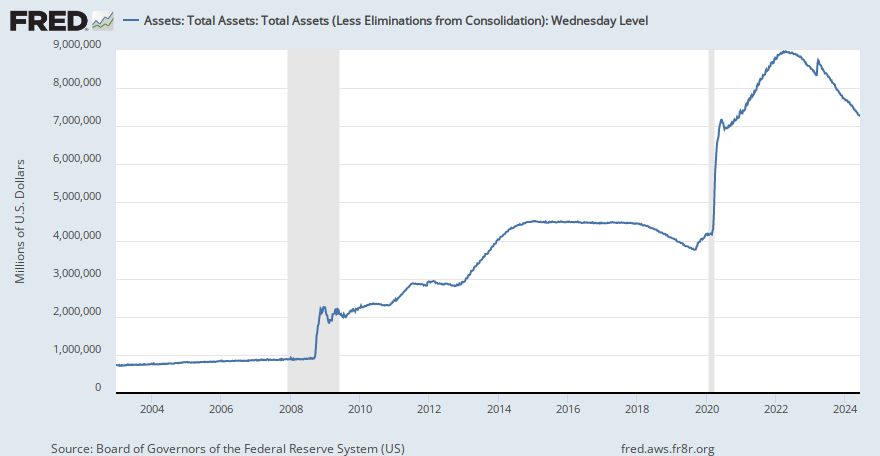
Now, I’m not an economist nor do I play one on this blog ... but I think I might have an idea what is going wrong. Over the last many months the Fed had reduced its balance sheet by over $600 billion (see chart) ... that had been bloated during the repeated “quantitative easings” employed during the Obama administration to hold our economy’s head above water.

The then-Fed chairman, Ben Bernanke expanded the Fed’s balance sheet by $3.6 trillion to $4.5 trillion (again see chart) by buying government bonds and mortgages ... see: Investopedia Entry This basically means that this same amount of readily-available money (M1) had been injected into the banking system ... resulting in pushing up asset prices and slightly stimulating the economy.

Enter stage right in 2017 President Trump ... and, as a reward, the Fed began to “burn off” its balance sheet, see: guerillastocktrading and the above chart. And the Fed also increased interest rates by 2 percentage points ... while Trump was reducing taxes and regulations. These are countervailing forces ... yet our economy started to grow much faster than had been the case. However, these Fed actions, combined with Trump’s trade war with China, has started slowing our economy down somewhat ... which would suggest a lower need for liquidity injections from the Fed.

So what is going on? My conclusion: Once any banking system gets used to a certain money supply, it cannot easily adjust to a markedly lower one ... no matter what Professor Bernanke had assured us. This may be due to inherent sluggishness in how the velocity of money changes?

Saturday, September 10, 2016

Inflation


Central banks around the world are pulling out all stops to try to counter what has been a persistent global deflationary trend. ... at least in developed economies. They have tried Quantitative Easings 1, 2, 3, etc. ... purchasing vast quantities of government debt and now even private debt to increase the money supply ... clearly to the point of diminishing returns ... since all this cash is not causing the sleeping giant of inflation to awaken. Of course, with all this debt on their balance sheets, they have also forced interest rates down ... even into negative territory ... so that all this debt doesn't crush their income statements and, more importantly, in an attempt to disincent private savers ... since saving negates spending which, in turn, is necessary for inflation.

What have been the consequences of all these central bank actions?

- I would argue that these central-banks' easy monetary accommodations have given the fiscal side of governments the license to spend beyond reason .. feeding the yaws of these ever increasing central banks' debt issuances. This will surely have longer-term consequences.

- Raising interest rates, particularly in the United States, has been like a trip to the dentist ... something put off until absolutely necessary. Don't forget that most 2015 projections had our Federal Reserve Bank raising rates four times in 2016. How many times so far? Zero! And that tooth is throbbing more and more. And I predict it won't happen before the election either ... since this might damage Hellary's chances. In December, it is more likely, especially if Trump is elected.

- Of course raising interest rates attracts capital from around the world which strengthens the dollar which then hurts exports and helps those countries importing here. Thus, the U.S. balance of payments gets even worse than it devastatingly is. This might be OK with Clinton but wouldn't sit well with Trump. He might lean on the Fed to weaken the dollar (not necessarily with interest rates) to help bring manufacturing back to America. The Fed might resist which would open another can of worms -- more federal government control over the Fed.

- The jury is out about what happens with government spending and deficits after the election. Both candidates have promised increased infrastructure spending and, Trump, a beefing up of our military ... while Hellary will open the spigots on social transfer payments. Taxes will likely go up under either candidate but, I would hope, under Trump, we might get real tax reform which might then spur our economy enough to reduce deficits. In Trump's case the Fed might be able to move more into the background except Trump might push to lengthen the term of our government debt. Clinton would still require a very accommodating central bank.

This is all very complicated with many fiscal and monetary cross currents. I wish I had the confidence that any of the world's central banks knew exactly what they were doing ... including our own. However, I think that one consequence is very likely to occur. Once all these monetary gurus have coaxed the inflation genie out of the bottle, that it will not stop at their targeted 2%. All this money in hiding around the world will then start sloshing around and may well sink a few of the more injudicious ships of state.

Friday, January 18, 2013

Race to the Bottom


The world is taking a dangerous and rocky path to universal monetary collapse.  Japan is now following the United States's Federal Reserve in devaluing its currency ... in order to give its economy a shot in the arm, see: CNBC Story.  The U.S. Fed’s Chairman, Ben Bernanke, has been pushing “quantitative easing” (QE) for the last three years in order to sop up all the debt that this country is forced to issue to cover it’s fire-hose federal spending … to the point where it has expanded our money supply (and its balance sheet) by $3 trillion.  And, in order to keep this crushing debt burden from sinking things further, it has kept generic interest rates artificially low with its banking muscle.  It has been able to run the monetary printing presses night and day without setting off crushing inflation because our economy is still so weak …  reflected in our poor employment and wage-increase statistics.

But one economic “benefit” of this monetary expansion is a weak U.S. dollar which tends to help export markets and crimp importers.  Given how poor the U.S. balance of payments actually is … image what a disaster it would be without the Fed’s dollar deflationary measures?  However, our trading partners are losing patience with us and, as indicated in the referenced article, are now mimicking Bernanke’s strategy.  The European Central Bank (ECB), China, Great Britain, Japan, and even Switzerland (for heaven’s sake) are falling over one another to try to devalue their currencies with their own QEs.  A U.S. Dollar slide begets a Chinese Yuan slide which begets an Euro slide which begets a Japanese Yen slide which begets a British Pound slide which begets a Swiss Pound slide.  This is all a very dangerous race to the bottom.

How will this end?  With all this quantitative easing, the world will be, in short order, awash in money.  The balance sheets of the central banks will have reached unsustainable levels … probably the ECB first; and the only way out will be for them to let the dogs out … allow inflation to reduce the carrying-cost pain of their excessive debts.  And, this time, run-away inflation will not be as localized as it was in Germany in the 1920s.  It will be world-wide and will engender political upheavals that are likely to be quite painful.  (At this point Bernanke will not look quite so angelic.)  So be forewarned and be prepared … own real hard assets (not cash) and owe lots of money … and live in an area of relative political sanity.