Showing posts with label Bernanke. Show all posts

Sunday, November 17, 2019

The Big Unwind


When in 2014 the Federal Reserve Bank’s Chairman Janet Yellen stopped Ben Bernanke’s  three rounds of Quantitive Easings that had held the Obama economy’s lhead above water ... and had expanded the Fed’s balance sheet by 3.6 trillion dollars, we were assured by Bernanke that this excess liquidity in its balance sheet could be unwound without any consequence ... see: Bernanke Plan.

Unfortunately, he was dead wrong. When this process was eventually started and before the Fed had reduced its balance sheet by $500 billion (mostly under Trump), it has had to reverse itself and pump about this same amount of liquidity back into the economy ... due to soaring repo rates.

So much for an august Princeton economics professor’s understanding of economics!

Wednesday, October 23, 2019

A Federal Case


The US Federal Reserve Bank has had to inject massive amounts of funds into the banking system recently as shortages have caused overnight interbank lending (repo) rates to spike over 7% whereas normally these rates hover around 1.9% ... see: CNBC Story. Many economists are scratching their heads as to why this drying up of liquidity has occurred. I have a thought ... bear with me.

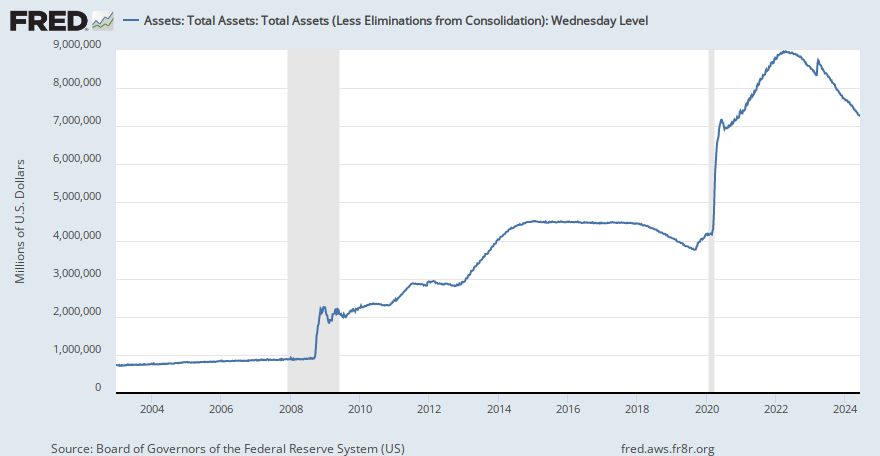
Now, I’m not an economist nor do I play one on this blog ... but I think I might have an idea what is going wrong. Over the last many months the Fed had reduced its balance sheet by over $600 billion (see chart) ... that had been bloated during the repeated “quantitative easings” employed during the Obama administration to hold our economy’s head above water.

The then-Fed chairman, Ben Bernanke expanded the Fed’s balance sheet by $3.6 trillion to $4.5 trillion (again see chart) by buying government bonds and mortgages ... see: Investopedia Entry This basically means that this same amount of readily-available money (M1) had been injected into the banking system ... resulting in pushing up asset prices and slightly stimulating the economy.

Enter stage right in 2017 President Trump ... and, as a reward, the Fed began to “burn off” its balance sheet, see: guerillastocktrading and the above chart. And the Fed also increased interest rates by 2 percentage points ... while Trump was reducing taxes and regulations. These are countervailing forces ... yet our economy started to grow much faster than had been the case. However, these Fed actions, combined with Trump’s trade war with China, has started slowing our economy down somewhat ... which would suggest a lower need for liquidity injections from the Fed.

So what is going on? My conclusion: Once any banking system gets used to a certain money supply, it cannot easily adjust to a markedly lower one ... no matter what Professor Bernanke had assured us. This may be due to inherent sluggishness in how the velocity of money changes?

Tuesday, June 12, 2018

Headlines


Trump casts North Korea summit as just a first date

The Fed has a surprise in store that could mean the end to interest rate hikes

John Kelly calls White House 'miserable place to work' ...

Giuliani warns Mueller bot to pull 'a Comey' and 'interfere' with midterms

France blasts 'incoherent' Trump after G-7 fiasco

A failed US-North Korea summit could make armed conflict more likely

AMAZON blasted over China factory conditions ...

Endogan predicts 'war between cross and crescent'

Kudlow: Trudeau 'stabbed us in the back'

Trump's stimulus will fade in 2020, when Wile E. Coyote will 'go off the cliff,' Bernanke says

Trump approval tops Obama, Reagan at same time in presidency ...

Justify wins Belmont Stakes to become 13th Triple Crown winner

Friday, January 18, 2013

Race to the Bottom


The world is taking a dangerous and rocky path to universal monetary collapse.  Japan is now following the United States's Federal Reserve in devaluing its currency ... in order to give its economy a shot in the arm, see: CNBC Story.  The U.S. Fed’s Chairman, Ben Bernanke, has been pushing “quantitative easing” (QE) for the last three years in order to sop up all the debt that this country is forced to issue to cover it’s fire-hose federal spending … to the point where it has expanded our money supply (and its balance sheet) by $3 trillion.  And, in order to keep this crushing debt burden from sinking things further, it has kept generic interest rates artificially low with its banking muscle.  It has been able to run the monetary printing presses night and day without setting off crushing inflation because our economy is still so weak …  reflected in our poor employment and wage-increase statistics.

But one economic “benefit” of this monetary expansion is a weak U.S. dollar which tends to help export markets and crimp importers.  Given how poor the U.S. balance of payments actually is … image what a disaster it would be without the Fed’s dollar deflationary measures?  However, our trading partners are losing patience with us and, as indicated in the referenced article, are now mimicking Bernanke’s strategy.  The European Central Bank (ECB), China, Great Britain, Japan, and even Switzerland (for heaven’s sake) are falling over one another to try to devalue their currencies with their own QEs.  A U.S. Dollar slide begets a Chinese Yuan slide which begets an Euro slide which begets a Japanese Yen slide which begets a British Pound slide which begets a Swiss Pound slide.  This is all a very dangerous race to the bottom.

How will this end?  With all this quantitative easing, the world will be, in short order, awash in money.  The balance sheets of the central banks will have reached unsustainable levels … probably the ECB first; and the only way out will be for them to let the dogs out … allow inflation to reduce the carrying-cost pain of their excessive debts.  And, this time, run-away inflation will not be as localized as it was in Germany in the 1920s.  It will be world-wide and will engender political upheavals that are likely to be quite painful.  (At this point Bernanke will not look quite so angelic.)  So be forewarned and be prepared … own real hard assets (not cash) and owe lots of money … and live in an area of relative political sanity.

Thursday, July 26, 2012

What Are the Chances ...


that the Federal Reserve Bank will initiate a third round of Quantitative Easing (QE3) anytime soon?  The New York Times weighs the pluses and minuses in a thoughtful analysis (see: NY Times Article).  Basically quantitative easing consists of the Fed issuing more debt and, simultaneously, buying it up so that more money is placed in circulation.  This makes the stock market go up, drives down interest rates even further, and weakens the dollar.(which seems acceptable since the dollar has been kicking the Euro's backside of late.)

However, the Fed is just one horse in an economic troika team that includes the fiscal side of the federal government and U.S. industry.  These other two horses are clearly not pulling their weight ... the administration and Congress because they are locked in a cage-match fight over whether Keynesian economics will ever work (it won't) ... and U.S. industry because it sees the new-taxes cliff looming in January and a much smaller chance that Obamacare will vanish (also add a hostile-to-business Obama administration).

My guess is that there is a strong possibility that the Fed will pull the lever on QE3 no later than its September Open Market meeting for no other reason than it too is a political animal (as we recently discovered the Supreme Court to be).  Fed Chairman Bernanke (and his sidekick, Little Timmy Geithner at Treasury) want to keep their sinecures and there is almost no chance that they will if Romney is elected.  Therefore, despite QE1 and QE2 not really pulling the U.S. out of the financial doldrums, Bernanke will force through QE3 to at least give Obama a fighting chance for four more years.  This is all The Barry will need to pulverize fully the U.S. economy.

Wednesday, July 18, 2012

Something Stinks


Ben Bernanke was testifying in front of a Senate Banking Committee yesterday (see: Miami Herald Article) and he was squirming.  He looked and acted chagrined when the subject of the recently disclosed manipulation of the Libor (London Interbank Offered Rate, a key worldwide interest rate benchmark) that has cost the Chairman and CEO of Barclays Bank their jobs.  It also probably has cost numerous players in the financial markets over the last four years billions, maybe hundreds of billions of dollars ... all because of illegal manipulation of this rate.  And, it seems that the Federal Reserve Bank of New York was on to this scandal as early as 2008 and possibly earlier.  This was when Little Timmy Geithner was running the New York Fed and Bernanke was running the whole Fed Reserve Banking shebang.  Their failings were obvious because, with a few phone calls, these two men could have, and should have killed this monumental malfeasance in its tracks.  But, it appears, they chose to emulate Penn State's Joe Paterno by conveniently looking the other way for all these years.  To me this is shameful behavior and emits a miasma that is not befitting of Bernanke.  Given Little Timmy Geithner's past tax peccadillo's, his lack of decisive action here does not seem out of character.

The feeble excuse that Bernanke offered was that such manipulation allowed these banks to appear, in 2008, financially stronger than they really were (a good thing?).  This then morphed into clear criminal behavior.  What good are regulators if they don't regulate?  Today Little Timothy Geithner also testifies in front of Congress and I expect him to be his old elusive self.  And when this scandal fully erupts (see: WSJ Article), I hope that, this time, these rats cannot run down the hawsers to their East Hampton and Martha's Vineyard get-aways.  I strongly suspect that they need to be fitted with some black and white stripped overalls and given an extended vacation in Leavenworth.  And don't be surprised if Congress's response is to demand more regulations ... quickly echoed by Elizabeth (Pow Wow Chow) Warren.

Tuesday, August 09, 2011

Deleveraging


Deleveraging (the reduction of borrowed money) is now what is happening in much of the world.  Many countries, mostly in the developed world, had gone on a borrowing binge to the point of severe pain.  Even though it is a year old, this CNBC slide show is eye-opening insofar as pointing out which nations are the world's biggest debtors as a percent of their GDPs ... see: Biggest Debtor Nations  (begorrah hint, Ireland is way out in front). And, if the United States Federal Reserve Bank had not led other national banks in keeping interest rates artificially low, the moneys of the free world would already be spiraling out of control into hyperinflation. 

In other words, the spending binges that these western governments (including the United States) had been on are unsustainable and the only two solutions are deleveraging through extreme austerity ... witness the resulting riots in Greece and England ... or Weimar-style hyperinflation.  The Standard and Poors downgrading of the sovereign debt of the United States is one indication that a tipping point in this process has been reached.  (One wonders, after viewing this slide show, how France and Germany have escaped this same Standard and Poors downgrade from their AAA ratings.)

Nevertheless, the U.S. has only two real Hobson's choices:
1) Listen to the Tea Party folks and stop the spending binge that we have been on for the last decade (and, maybe, overhaul the tax system when this economic slowdown is over), or
2) Keep printing money until bread costs $1,000 a loaf.  (The day after the recent $400 billion debt-ceiling increase, little Timmy Geithner wrote checks for $239 billion ... 90% of which were cashed by Ben Bernanke at the Federal Reserve Bank.  In other words, we printed that much money in one day -- a very good start toward Weimar.)

The question now is which way do we go?  Do we inflate our way out of our rapidly growing debt morass?  Or can we rein in the tax-and-spenders whose only vision extends through the next election?  (I do think that the only real difference between these options is that the pain of austerity is felt mainly by the younger population whereas the pang of hyperinflation is felt by us oldsters.)  Seeing the recent lack of real political will in this country ... and the degree to which the Tea Party is being castigated by the main-stream media ... my (rapidly devaluing) money is still on the former option -- hyperinflation.

Yes, hyperinflation will be painful ... just as painful as austerity measures ... if not more so.  But we are a democracy and our people, in their childlike naivete, get to pick their poison.

Thursday, March 19, 2009

Breaking the China


Federal Reserve Chairman Bernanke announced yesterday that his organization will pump over one trillion dollars into the U.S. economy by buying up U.S. Treasury securities and mortgage-backed debt. (See Bernanke Buyback). This bold move has caused interest rates to plummet, the price of Treasury securities to rise, and the U.S. dollar to weaken around the world. It is now predicted that long-term mortgage rates will now decline to the 4% - 4.5% range. This buyback should include as much as $300 billion of long-term treasuries and cause the government printing presses to work overtime to print all the required dollars. Now, there may be an interesting wrinkle to this announcement. China has recently complained about its massive holdings of U.S. debt obligations (See China Complaint). It is estimated that they hold as much as one trillion dollars of U.S. debt and, if they were to decide to unload these holdings back to us, the price of such debt would plummet and U.S. interest rates would increase in step.

Now I have to wonder if these news stories are linked? Is Bernanke perhaps rubbing China’s belly by allowing it to sell a bunch of their U.S. debt holdings back to us under more favorable conditions? Isn’t it funny that effectively the same action (the Federal Reserve Bank buying back U.S. debt) can have totally opposite effects depending on who initiates the transaction? And, if my speculation turns out to be correct, then the U.S., under the wing of our International President, Hillary Clinton, clearly has blinked first.