Showing posts with label quantitative easing. Show all posts

Wednesday, August 26, 2020

Bulls and Bears


Had a conversation with a stock-savvy classmate on Monday. Asked him if he thought our stock markets were hitting record highs because the Wall Street pros thought Trump would win in November? His response was that it was more likely due to the enormous liquidity being pumped into our economy by the Federal Reserve Bank because of Covid. (Money has to be put to work somewhere.)

This is certainly likely ... since we saw this same stock market rise during the Obama administration due to about $10 trillion of liquidity injected during the Fed’s three phases of Quantitative Easing  ... combined with essentially zero interest rates.

Now that we effectively have zero interest rates back again, this is another inflator of stock prices. The prevailing interest rate is what one uses to discount the future corporate earnings stream to establish its stock price ... and forever zero rates thoeortically justify infinite stock prices. Calm down pilgrim ... it’s just theoretically ... we’re living in the real world ... and nothing is forever.

But, somehow I have to believe that if it becomes obvious  the Biden/Harris ticket will be clear winners (and the fake Indian as Treasury Secretary), we would not be hitting new stock market  highs ... more liquidity or not.


STAND UP FOR AMERICA!

Wednesday, October 23, 2019

A Federal Case


The US Federal Reserve Bank has had to inject massive amounts of funds into the banking system recently as shortages have caused overnight interbank lending (repo) rates to spike over 7% whereas normally these rates hover around 1.9% ... see: CNBC Story. Many economists are scratching their heads as to why this drying up of liquidity has occurred. I have a thought ... bear with me.

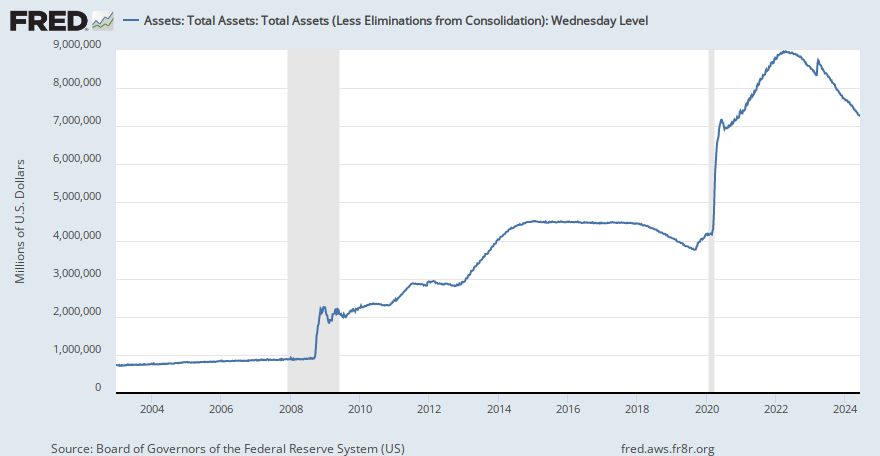
Now, I’m not an economist nor do I play one on this blog ... but I think I might have an idea what is going wrong. Over the last many months the Fed had reduced its balance sheet by over $600 billion (see chart) ... that had been bloated during the repeated “quantitative easings” employed during the Obama administration to hold our economy’s head above water.

The then-Fed chairman, Ben Bernanke expanded the Fed’s balance sheet by $3.6 trillion to $4.5 trillion (again see chart) by buying government bonds and mortgages ... see: Investopedia Entry This basically means that this same amount of readily-available money (M1) had been injected into the banking system ... resulting in pushing up asset prices and slightly stimulating the economy.

Enter stage right in 2017 President Trump ... and, as a reward, the Fed began to “burn off” its balance sheet, see: guerillastocktrading and the above chart. And the Fed also increased interest rates by 2 percentage points ... while Trump was reducing taxes and regulations. These are countervailing forces ... yet our economy started to grow much faster than had been the case. However, these Fed actions, combined with Trump’s trade war with China, has started slowing our economy down somewhat ... which would suggest a lower need for liquidity injections from the Fed.

So what is going on? My conclusion: Once any banking system gets used to a certain money supply, it cannot easily adjust to a markedly lower one ... no matter what Professor Bernanke had assured us. This may be due to inherent sluggishness in how the velocity of money changes?

Tuesday, February 10, 2015

The Wizard of Oz


Supposedly the U.S. Federal Reserve Bank stopped its quantitative easing (QE) program this past October (wherein it bought $40 billion of government debt and mortgage-backed securities every month to essentially expand the U.S. money supply … see: Yeasty Blog Entry.) This being the case, how come the Fed’s balance sheet expanded by $187 billion dollars in the last two months (over four times its QE targets) … see: CNBC Story? And why are we just hearing about this now? And what was the purpose of this unexpected monetary expansion?

Our Federal Reserve Bank is a quasi-governmental agency with enormous powers that operates mostly in the dark … manipulating monetary levers and turning interest-rate dials that have enormous impact on the economic health (or illness) of our nation. In a way, one could compare this group to the Wizard of Oz … creating its “great and powerful” image from behind the curtain. For the most part it has operated with a benign ethic (we hope) … but there is the implicit threat of it falling under the control of someone with evil intent. To Senator Rand Paul this is a dangerous situation and he wants Congress to have audit control over this institution … he wants to be like Toto pulling back the curtain on the Wizard of Oz … see: Forbes Story.

Up until now, I had hoped that this was not a necessary intrusion into the workings of the Fed. After all Congress doesn’t have a stellar reputation of late for not politicizing things … but, with this latest Fed revelation, I now feel that a little more careful oversight might not be a bad idea.

As Ronald Reagan once said, "trust but verify."

Afterward: We have had at least two quasi-govenrmental institutions that have been corrupted of late ... Fannie Mae and Freddie Mac ... good enough reason to worry about this happening to the Fed.

Thursday, January 22, 2015

Currency Wars


The world is a boil with currency devaluations, interest rate cuts and quantitative easings (QEs) by numerous central banks. Because of the recent slump in oil prices, the Canadian central bank has just cut its lending rate … with another commodity exporter, Australia, expected to follow suit shortly … see: CNBC Story. And today Mario Draghi of the European Central Bank is expected to announce the start of another QE program totaling perhaps 500 billion euros … see: Another CNBC Story.

I have in the past commented on what has degenerated into a major pissing contest between the central banks of the more developed nations and what the consequences that might result are … see: Race to the Bottom. It seems to this observer that the world has been lulled into an expectation, led by the now retired Chairman of the U.S. Federal Reserve Bank, Ben Bernanke, that central banks are the panacea for all the world’s economic woes.

Clearly monetary policy, in the long run, cannot solve basic economic malaise … yet the world’s stock markets now seem addicted to the opiate of easy money and very low, even negative, interest rates. This cannot all end well … at some point, possibly sooner than we wish, as Obama’s reverend, Jeremiah Wright, would say, “the chickens will come home to roost.”

What is now an illogical deflationary monetary and commodity spiral, I somehow expect, will flip into run-away inflationary in a nanosecond. Money is, after all, just gussied-up pieces of paper representing a political promise. Be prepared for these promises to be broken …

Thursday, December 04, 2014

Yeasty


There is an old Wall Street adage for investors, “Don’t fight the Fed,” meaning the Federal Reserve bank has a lot to do with the direction of the stock market. If the Fed is reducing interest rates and expanding the money supply, then the stock market should go up … and vice versa. Over the last eight months we have seen a perfect example of this working in Japan where its national bank has been engaged in this very process, it’s own version of “quantitative easing” (QE) … see: The Economist Explanation.  It is basically printing yen to a fair-thee-well while holding interest rates at zero (see: Trading Economics.) The result … the Nikkei 225, the primary stock index in Japan has been quite yeasty … going from 14,000 to 17,900 in just the past eight months, a 29% gain (almost 42% on an annualized basis) … see the chart below:

Nikkei 225

And this has occurred during a period of effectively an economic recession in Japan. Also note that the yen has weakened considerably against the U.S. dollar … going from 102 per dollar to now almost 120 per dollar. This obviously helps the Japanese exporters but does nothing for American investors in Japanese stocks as it has cut into their gains in yen after converting these yen back into dollars.

Now comes the rub. The American stock market has been on a roll ever since the U.S. Federal Reserve Bank started its own QE back in 2009 (see: NY Times Article.) This impetus has also helped the U.S. stock market considerably … boosting the American stock market’s Dow Jones Average from below 7000 to 17900 during this same six year period … also quite frothy ... see the chart below:

Dow Jones Average

The issue then becomes, will the U.S. stock market continue on its extended roll even after the Fed stopped the money supply expansion part of its QE program two months ago? The next shoe to drop will be when it increases interest rates ... maybe next summer.

Personally, I’m not one to fight the Fed …

Sunday, December 08, 2013

Bitcoins


People with excess cash are in a bit of a quandary about where to park it ... forget about current money-market funds or CDs.

Expecting higher interest rates this coming year due to the Federal Reserve Bank's backing off of its quantitative easing, bonds are really not a very good investment at the moment … higher interest rates mean lower bond prices … often more than wiping out any interest income. 

And although the stock market has done very well over 2013, it is unlikely that it will repeat this feat to the same degree in 2014.
  
The next option is real estate.  However, higher interest rates mean higher mortgage rates … and the Fed should also be reducing its mortgage repurchasing program … both meaning that housing is unlikely to keep on the recovery pace that it has enjoyed recently.  (It still might be the best place to put some excess funds however.)

Another popular speculative investment, commodities, also tend to suffer when interest rates go up because the carrying costs of commodity purchases steal much commodity price-increase benefit.

And sovereign currencies are a very dangerous place to invest because the machinations of the world’s central banks are difficult to predict and fraught with shady dealings. 

Even the fine art market, although showing some spectacular recent sales, overall is not doing very well … see: New York Times Article.

What to do?  There are always bitcoins (see: LA Times Article … just kidding.)

And, the last time I looked, you can’t stuff cash into a Tempurpedic mattress …

Thursday, July 18, 2013

The Punch Bowl Saga


Federal Reserve Bank Chairman, Ben Bernanke, is testifying in front of Congress again today ... very likely for the last time.  And he is telling both houses and the stock markets exactly what they want to hear ... that monetary tightening will not be started by the Federal Reserve Bank "for the foreseeable future" (see: CNBC Story). This is in stark contrast to what he said one month ago when he suggested that the Fed's tapering-off of its quantitative easing ($85 billion of money printing per month) would begin later this year and would likely be done by mid-year next (see: How Many Angels). Predictably these previous Bernanke remarks caused interest rates to soar and the stock market to swoon.

So the candy-man, Ben has appeared to reversed himself and promised to keep pumping money into the financial markets ... an action that is now being frequently compared to providing a dope-fix to drug-users. In the past, the Fed's job has been rather compared to taking away the punch bowl just as the party is getting a "glow-on and singing fills the air."  Only this time, Bernanke has seemingly lost his nerve and is refilling the punch bowl with grain alcohol ... probably not the long-term smartest thing to do for the U.S. economy.

But then how many smart things is this country doing these days anyway?

Tuesday, March 05, 2013

The Uninformed Voter


Even with the stock market hitting a new high, I think that there is a reasonable chance that the U.S. economy will experience a slow-down, if not a double-dip recession, this year.  The fourth quarter of last year's GNP growth has been revised up to a still-anemic +0.1% and four significant economic events have occurred since then: 1) as a result of the fiscal cliff, an increase of the tax rate on high-earners to almost 40% and on dividends to 20%, 2) an increase in the payroll tax rate on everyone by 2 percentage points, 3) the real start of the myriad taxes and regulations associated with Obamacare, and 4) the $43 billion reduction in federal spending that came with the recent sequestration.  With the continuing government spending resolution due to occur in Congress at the end of this month, there is still another element of uncertainty facing American companies ... causing them to approach any business expansion with caution

OK, given that an economic slow-down might occur, how will it be viewed by the uninformed voters in the U.S.?  Obviously, the Obama Administration will be beating the demagogic drums and blaming such a slowdown on the sequestration events.  But, as can be seen from above, three tax increases will be taking considerable money out of the economy and giving it to the government (see: Breitbart Story) whereas the sequestration might slightly ease the pressure on the Federal Reserve Bank to fund America's crippling deficits ... which, I think, might even be a plus for our economy.  And, given that this country will still be running close to a trillion dollar fiscal deficit this year and the Federal Reserve Bank will still be printing about $85 billion of monetary stimulus each month (with "quantitative easing"), by all logic an economic slowdown should not occur.  So, if and when it does as I predict, it should be fully the responsibility of the Obama Administration and its hostile business and taxing environment.

But do you think that uninformed voters will understand this logic?  Or will they give the Democrats even more (destructive) economic leverage in the Congressional elections of 2014?

Thursday, September 13, 2012

100%


Back on this July 26th in this blog, I asked the question, "What are the chances?" (referring to the probability that Ben Bernanke would help Obama get re-elected by instituting additional quantitative easing ... see: Blog Entry).  As it turns out, the answer is 100% (see: CNBC Story).  Is this so surprising?  If you were Ben Bernanke, wouldn't you want to keep your lucrative job for four more years ... particularly in this piss-poor economy?  (Screw your grandchildren!)