Showing posts with label politics. Show all posts
Saturday, August 08, 2020
Friday, July 03, 2020
Fudge
I have been perplexed at the disconnect between the spike in COVID-19 cases and the continued downward slope of the deaths from this virus ... even with a two week plus lag. How can this be? Well I have posited some reasons: the virus is weakening, there are better therapeutics, mostly young people, with less morbidity being infected, etc. But I have not considered another possibility — the new cases numbers are being fudged!
How can this happen ... and why? Well the why is fairly obvious — politics is involved ... more cases equals longer lockdowns and slower economic recovery ... equals problems for the Orangeman.
The “how” is just now being discovered. In Texas at least, health authorities have changed the definition of those with COVID-19 from one who tests positive for this virus to, ta-da, someone who has been in close contact with this positive person ... whether this “contact” tests positive or not! Clearly, good reason to see the number of cases surge in this state ... see: Conservative Treehouse explanation.
So, can politics affect public health? You bet your bippy!
Now, kind reader, are other fudgings of case counts happening elsewhere? We will have to wait and see. But, if new cases keep surging while new deaths keep to their downward path, one would have to suspect so.
Labels:
COVID-19,
definition,
Disconnect,
Fudge,
new cases,
new deaths,
politics,
Texas,
therapeutics,
weakening virus
Tuesday, June 02, 2020
Braver New World
- Social justice trumps justice
- End discrimination by discriminating
- Judge people by the color of their skin, not by the content of their character
- Social distance except when rioting or having sex with strangers
- It is healthy to pay healthy people not to work
- Lying is an integral and expected part of politics
- Equality of outcome is more important than equality of opportunity
- All organizations’ diversity profiles must match overall national demographics exactly
- Tribalism is primary ... above religion, nationalism and family
- Virtue signaling is much better than actual virtue
- Bending of young minds is far more important than primary education
- Owning a gun means you want to shoot up a school
Sunday, May 31, 2020
Pie Eyed
![]() |
| From Diagones’ Middle Finger |
American politics ...
Labels:
Diagones’ Middle Funger,
Pie Eyed,
politics
Tuesday, May 12, 2020
Sunday, April 26, 2020
Contact Tracing
There have been close to a million diagnosed cases on COVID-19 in the United States ... and four antibody studies suggest that the real number of those infected might be as much as 14 to 50 times this number.
So, are we going to be able to contact trace at least 14 million Americans and then to the contacts so mentioned (5+)? I kinda doubt it. Just the number of those performing this contact tracing would be in the hundreds of thousands. Hiring and training this small army would take months, if not years.
Is this not just another red herring thrown into this process by those who put their politics ahead of our economy?
Labels:
antibody studies,
Contact Tracing,
COVID-19,
economy,
politics,
Red Herring
Wednesday, January 15, 2020
Tuesday, June 11, 2019
Monday, May 13, 2019
Tuesday, September 04, 2018
Wednesday, August 29, 2018
Wednesday, April 04, 2018
Another Contrast
I have previously enjoyed comparing President Trump with his predecessor, Obama --- style vs. substance, process vs. politics, etc. Now I have another idea about how to draw this contrast and why Trump has generated so much anxiety and animosity among his opposition. This time the contrast has to do with visibility. Because of his continuous tweeting, President Trump is very much an open book regarding his positions and direction ... very likely why his base is so attracted to him.
In contrast, a lot of President Obama's "fundamental change" was accomplished behind the bureaucratic curtain ... in the deep state. Yes, Obama did communicate well with his TelePrompter ... but it was mostly in his own kind of code. Much of his real intent was not on the surface. In fact, he also put forward much purposeful mendacity like Obamacare ... whereas, much of Trump's "lying" is indicative of his round-about decision process. It is an iterative process involving a series of zeroing in on his final policy. This process can be upsetting to those who don't believe that Trump's heart is right ... particularly when the media fans the foams of these anxieties.
To summarize in just a few words: Trump is up front with a nationalist populist agenda whereas Obama was folksily opaque with a globalist new-world-order objective.
Labels:
nationalism,
new world order,
Obama,
policy,
politics,
Populism,
style,
substance,
Trump
Thursday, December 28, 2017
Sunday, November 26, 2017
Tuesday, October 10, 2017
Friday, April 21, 2017
Erasures
Much of social activism today is an obsessive attempt to erase boundary lines ... between genders, between religions, between political ideologies, between races, between economic castes, and even between countries. This seems the uncomfortable result of trying to reconcile the natural incompatibility between diversity and inclusion.
Saturday, March 25, 2017
Friday, January 06, 2017
Why Movies No Longer Move Me
I don't think that I have gone to a motion picture show for years. And I also find it difficult to get enthusiastic about even watching Hollywood's output on television. Why you ask? Here are a few reasons:
- So many actors and actresses seem compelled to express their grating political views publicly that these personae show through their dramatic masks on the big screen.
- Too many flick scripts are either, on their face political, or continuously suggest ideologies during otherwise innocent scenes. This works to keep me from suspending my disbelief.
- It probably is that I have grown away from our current hedonistic ethos, but I find it difficult identifying with the base interests and motivations of many current scriptwriters. Movies used to be predictably uplifting and entertaining. Now they are mostly downers.
- Our cinema has become so formulaic and derivative that, once knowing the subject of the film, I can usually fill in many of the details. The fifty-third sequel of Star Wars just has somehow lost its luster to me.
- Even apart from politics, many of the current crop of movie stars are just not likable to me. Perhaps because their scuzzy private lives have become so public on social media?
- Many too many Tinseltown outputs involve hidden promotions or product placements to the point of comparison to television ... which has become one continuous ad interspersed with a smattering of entertainment.
- Ticket prices keep going up without seeming limit ... and $8 popcorn seems a little excessive.
- Movie audiences are packed with superficial millennials. Clearly I and my kind are not the target audience ... and so I feel increasingly alienated. As a tyro curmudgeon need I say more?
Afterward: See: The Diplomad's Thoughts on Same.
- Ticket prices keep going up without seeming limit ... and $8 popcorn seems a little excessive.
- Movie audiences are packed with superficial millennials. Clearly I and my kind are not the target audience ... and so I feel increasingly alienated. As a tyro curmudgeon need I say more?
Afterward: See: The Diplomad's Thoughts on Same.
Monday, May 23, 2016
Payola
Back in the 1960's there was a national scandal when it was discovered that music production companies were giving cash and other consideration to radio disc jockeys to play their records on the air. This bribery scandal was nicknamed "payola" and it caused a general wringing of hands and a few slaps on the wrists. But one record spinner, Alan Freed, lost his jobs and was ruined ... see: Payola. As a result, such blatant bribery in the sleazy music industry is looked on unfavorably even today. This, of course, doesn't say that it has disappeared ... it is now just further underground.
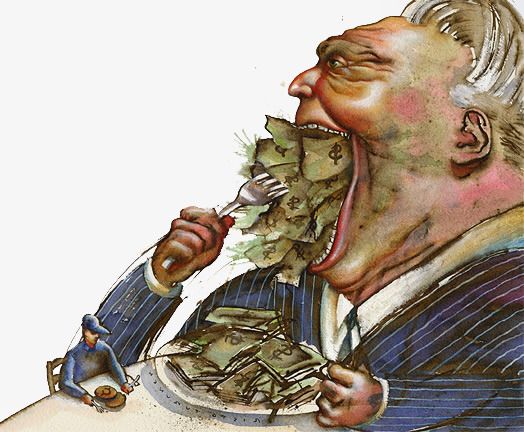
But there is another sleazy industry where different kinds of payola is rampant ... politics ... making the old form seem like penny-ante poker. Politicians have invented numerous ways of lining their pockets with mucho cabbage ... huge book advances that are never earned back, astronomical speaking fees for pedestrian comments to assembled employees, campaign contributions which are never spent and revert to the politicians, cattle futures trading where only winning trades are recorded, taxpayer purchased items misappropriated when leaving office, etc., etc. Have you noticed how very few politicians depart their jobs as paupers? The vast majority, no matter how poor they were when they were elected, retire into abject luxury.
Enter the Clintons who have used every one of these scams (and more) to go from rags to riches. Hellery Clinton on her own, since leaving the State Department, has received $21.7 million in speaking fees from fawning corporations ... see: New York Post Article. Have you heard her speak? She utters platitudes in an arm-waving screech that can't be worth her airfare, yet she was in high demand. She also got a $14 million book advance from Simon & Schuster for that ghost-written book, "Hard Choices", that was almost unreadable. This publisher was lucky if it made back half of its payola advance.
These speaking fees and book advances are obviously bribes to curry favor were she to be elected President. Ask Donald Trump ... he was often on the dispersing side of such payola. And how has Bernie Sanders become so popular? I contend that one chief reason is that he has positioned himself outside of this payola swamp ... possibly the main reason that Bernie is ahead of Trump in current polls. (Trump would do well, if he thinks that Sanders has a shot at the nomination, to attack this impression.) So, of the three candidates still standing, we have one payola receiver, one payola payer, and one who seems not to be either. One can almost handicap this November's election just based upon these profiles.
Wednesday, October 01, 2014
The Debate
Yesterday I participated in a Skype call with a bunch of my
homies from college days … many of whom read this blog. In this conversation I
was jibed for a blog entry in which I criticized New Hampshire Senator Jeanne
Shaheen for attacking Scott Brown over his support for the oil depletion
allowance ... calling it a government subsidy for the rich oil companies. In it I equated this non-cash write-off allowed oil exploration
companies to depreciation allowed other corporate taxpayers … see: Energy Independence.
To defend myself I thereafter participated in an e-mail
debate with two of my homies in which they both took the position that this
accounting entry was unfair. I think that this debate was a lively and edifying back
and forth and so I want to reproduce it here. In order to protect the
identities of these two opponents, I have given them aliases … Dr. Kildare and
Godot. I tag my arguments with “Me.” Here is the verbatim trialogue:
Me: (replying to a comment made during the Skype call that mining companies don’t get an equivalent write-off as oil exploration companies.) See: http://www.taxpayer.net/library/article/the-percentage-depletion-allowance-pda-a-double-giveaway.
Even for land for which there is no payment. This would be wrong in my
book ... [George]
Me: By the way [Godot] ... you
asked if steel companies should be allowed to depreciate the ore that they use
to make steel ... if they buy this iron ore, they have a full tax right-off
immediately ... as it is considered an operating expense [I should have said "cost of goods sold"] in the income
statement. If they own the iron ore pits, then see my previous e-mail. George
Godot: George...thanks
for this clarification. So the Feds do allow certain companies mining
"critical" materials such as uranium, silver, etc. to get a depletion
credit. We could certainly classify oil as a critical material. But in both
cases, these credits or write-offs are little more than gifts from the
taxpayers given to industries that are doing just fine on their own....which
you seem to agree with. It is pure political pork. So will there be an
update/revision of your earlier blog?
Me: [Godot], You, I think, once had a rental property ... which, I
suspect you depreciated on your tax forms. This is the same as depreciating a
piece of oil producing land. There is one major difference however ...
oil-producing land does get less valuable after the oil is extracted.
However, rental real estate generally gets more valuable over time.
Perhaps then we should eliminate this notion of allowing depreciation
deductions on the tax returns for rental properties ... but keep it on oil
lands? George
Godot: George...the
basic difference between a rental property and oil in the ground is that the
rental property is an asset one has to use other assets (usually cash) to
acquire. Real estate wears out over time and use and that is the basis for its
depreciation. Whether its sale price increases in value over time is immaterial
to the depreciation value which is based strictly on what one originally paid
for it...and that the value increases is far from certain. I have invested in
real estate that has sold for much less than I paid for it (unfortunately). Oil
companies should be allowed and are allowed to depreciate the assets they need
to use to find and extract the oil from the earth....equipment, land purchases,
leases, etc. Allowing oil companies to depreciate the actual oil they
find, if any, continues to be a rip-off that we all pay for. Under this
concept, all minerals mined from the earth should therefore be depreciable. We
could even let DeBeers Diamonds have a tax write-off for every one of the
diamonds they extract from their mines. [Godot]
Me: [Godot],
Differentiating between the oil in the ground and the ground itself is
sophistry. The oil depletion allowance IS depreciating the value of the land
from which the oil is being extracted. So, can I assume you agree with me?
George
Dr.
Kildare: OK. I went to the web to look up "oil
depletion allowance". There are several articles there defining the
concept. It is a depletion allowance, not a depreciation, to allow recovering
the cost of buying a mineral. I still think it
is a kaka concept: You make money selling the oil, after taking off expenses of
recovering the oil, and then receive a payment for having less oil, that you
just made a bunch of money buy selling it.
Me: [Dr.
Kildare], So when you have a rental property you should not be allowed
to depreciate it because you are also receiving rents from the people renting
said property? Don't forget this depreciation is on top of the money you spend
(and deduct from declared income) to rent the property ... taxes, mortgages,
upkeep, advertising, etc. These two concepts, to me, are analogous. George
Dr.
Kildare: the depletion allowance is specifically for the mineral. Oil companies do not buy land. It is done
through leases, thus enriching some guy who owns useless desert land in
Oklahoma.
Godot: "Land"
that an oil company has to buy or lease for its drilling exploration might be
legitimately depreciable. Land, in general according to GAAP, however, is not
depreciable because land does not wear out or get used up.. George is talking
about oil in the ground, or more specifically, an asset the oil company has not
paid for. Therefore should not be allowed to write-off.
Me: [Godot],
You say, "oil in the ground, or more specifically,
an asset the oil company has not paid for. Therefore should not be allowed to
write-off." Are you telling me that the purchase or
leasing of land under which oil may be found is the same as that for land for
grazing cattle? Come on!! George
Godot: George
... from a tax point of view, land is land. However, as your article points out
certain industries get favored nation tax treatment. If the oil industry were
an endangered species, I might agree. But we both know the oil industry is
doing quite well. So the depletion allowance is pure political poppycock.
Me: [Godot], I
thought we were arguing accounting ... and you have slipped over into politics.
I think you are confusing oil refining companies with oil exploration
companies which are far riskier. If you agree with me about the accounting
treatment, then we can discuss the actual amounts involved. I do believe that
newer technologies might require the revisiting the formulas used for oil
depletion allowances ... but I myself will not reject this accounting concept.
The counter argument, in my mind, is a purely political calculus. George
Dr.
Kildare: The law, for oil in the ground, is a special case, as
passed by Congress. that is why the law exists. and is also the cause of
the yowls of those opposed to it. This is not a standard and usual
accounting rule. The depletion allowance is an exception to usual and customary
to allow the oil companies to recoup some $. It is specifically for loss
of the volume of oil in the ground each year and has nothing to do with how the
rights to extract the oil were obtained. It is prorated yearly until the
company has recouped all of its investment and then goes away. Any expenses to
the oil men for obtaining rights to drill, remove the oil from the ground or
sell it to me and thee are handled by usual and customary accounting. The screeching I have always heard relates to the fact
that the oil company never paid for the oil in the first place. They paid
for a lease and spent money looking for and extracting oil which they then sold
at a profit. They paid someone the gamblers ante at the outset on the
come that there was oil under the land. They did not have a guarantee that
there was oil there so I believe it is specious to say that they paid the land
holder for his oil.
Me: [Dr.
Kildare], And, if there is no oil there, do they get any oil depletion
allowances? NO ... they ate these upfront costs. Your description, to me,
sounds an awful lot like the equivalent of depreciation ... and I am reasonably
sure that this was the argument that was made to Congress to get them to agree
to these non-cash charges to their income statement. You say that the oil
exploration company never paid for the oil to begin with ... and I say that
they paid a lot more to buy or lease this land than they would have to use it
to graze cattle. They also had considerable expense to drill, extract, and
distribute this oil ... if any turned out to be there. These expenses could
easily offset much of their eventual [dirty] profit. Ergo they deserve to
recoup all or part of this extra purchase or lease expense (and even that money
which they sunk into dry holes) through this depletion allowance. Without this
non-cash tax allowance, we probably would still be quite beholding to the
Mid-East potentates. If it walks like a duck ... Do you really want to
discourage such strategic energy exploration by removing this (to me,
meaningful, rational and time-tested) accounting incentive? George
Me: [Dr. Kildare], One more
thing. And to call it a "subsidy" is demagogic pandering to the uninformed
voter. This suggests that the government gives these oil exploration companies
taxpayer money. No, the oil-depletion allowance is just a non-cash charge ... a
reduction in the amount of taxes owed against any revenues generated (exactly
like depreciation is). George
Readers ... if you are still here ... I thank you for your indulgence. I do think that this is a very important topic ... if somewhat in the weeds.
Subscribe to:
Posts (Atom)

:max_bytes(150000):strip_icc()/super-easy-fudge-102016-58188f0c3df78cc2e893a23f.jpg)