Showing posts with label artificial intelligence. Show all posts

Wednesday, June 10, 2020

Artificial Stupidity


As a frequent user of Google searches ... both text and images ... I am not a slavish admirer of its “artificial intelligence” technology. In particular, this big corporate proponent of diversity shows little or no diversity in its search results. It’s often like they are not paying attention to the search question. Let’s then call it “artificial stupidity.”

For instance, if I search for images of  “Doolittle,”  I will get pages and pages of images of that Eddie Murphy movie with the same name and hardly anything of what I am really looking for ... the World War 2 air commander. And on the text-search side, Google’s  (and even DuckDuckGo’s) “algorithms” overwhelming return current-event examples with virtually no historic perspective ... like an attempted reference to prior race riots.

And I have yet not delved into Google’s political bias. Today I did a Google search on “racism” and, surprise, surprise, the first three news returns were about VP Pence, President Trump and the Republican party. Hogwash!

Now, I suspect that there might be more sophisticated ways of doing such searches (using Boolean operators?), but, even if there are, 99.9% of users of these searches will not take the time to learn or use these “sophistications.” It seems clear to me that a search engine, for the novice user, could be made much more sophisticated and diverse ... maybe offering alternative paths to follow ... and any technology company that does this will possibly replace Google’s strangle hold on this technology.

I’ll take just a 10% finder’s fee.

Saturday, July 27, 2019

Armageddon


There are quite a number of threats to the survival of our culture ... even our people. Whether they actually mean that the Earth will turn into Mars is dubious, but some actually might pose this menace. I have listed below real and imagined Armageddons ... in a descending order I consider reasonable. Each deserves its own extensive blog entry ... which I may well do. You may differ with the sequencing, but I doubt that you will dispute these items themselves:

Nuclear Proliferation — Nukes in the hands of lunatics

Top-dog Hegemony — China vs. Russia vs. USA vs. radical Islam ... unless the U.S. wins, things will be over

Plague — Biological weapons or natural pandemics might easily wipe out huge numbers of people

Artificial Intelligence — The nutroots are constantly predicting that robots will rule us. I am dubious.

Climate Change — the Earth has been getting warmer since 1750. Will it burn up as many predict? Maybe in a few million tears ... but not tomorrow.

Green Energy — I think that capturing energy from the wind and tides may present some unintended consequences.

Recreational Drugs — opium once almost took down China. It is conceivable that the legalization and propagation of mind-altering drugs could profoundly affect our future outlook.

Designer Babies — DNA-altering medicine will be changing our offspring and lives in ways not fully understood. Are we in for a planet full of Frankensteins?

Population Bomb — thirty years ago this was close to the number one fear. However populations are leveling off and declining everywhere bu Africa. Thus threat is therefore small.

Famine — the reduction of population pressure combined with higher crop yields reduces the possibility of widespread famine.

Big Data — although not threatening the end to civilization, the collection of massive amounts of personal data through social media and otherwise does pose a serious danger to our freedoms.

UFOs — Sorry Tucker ... not a threat.

Tuesday, April 23, 2019

Neural Networks


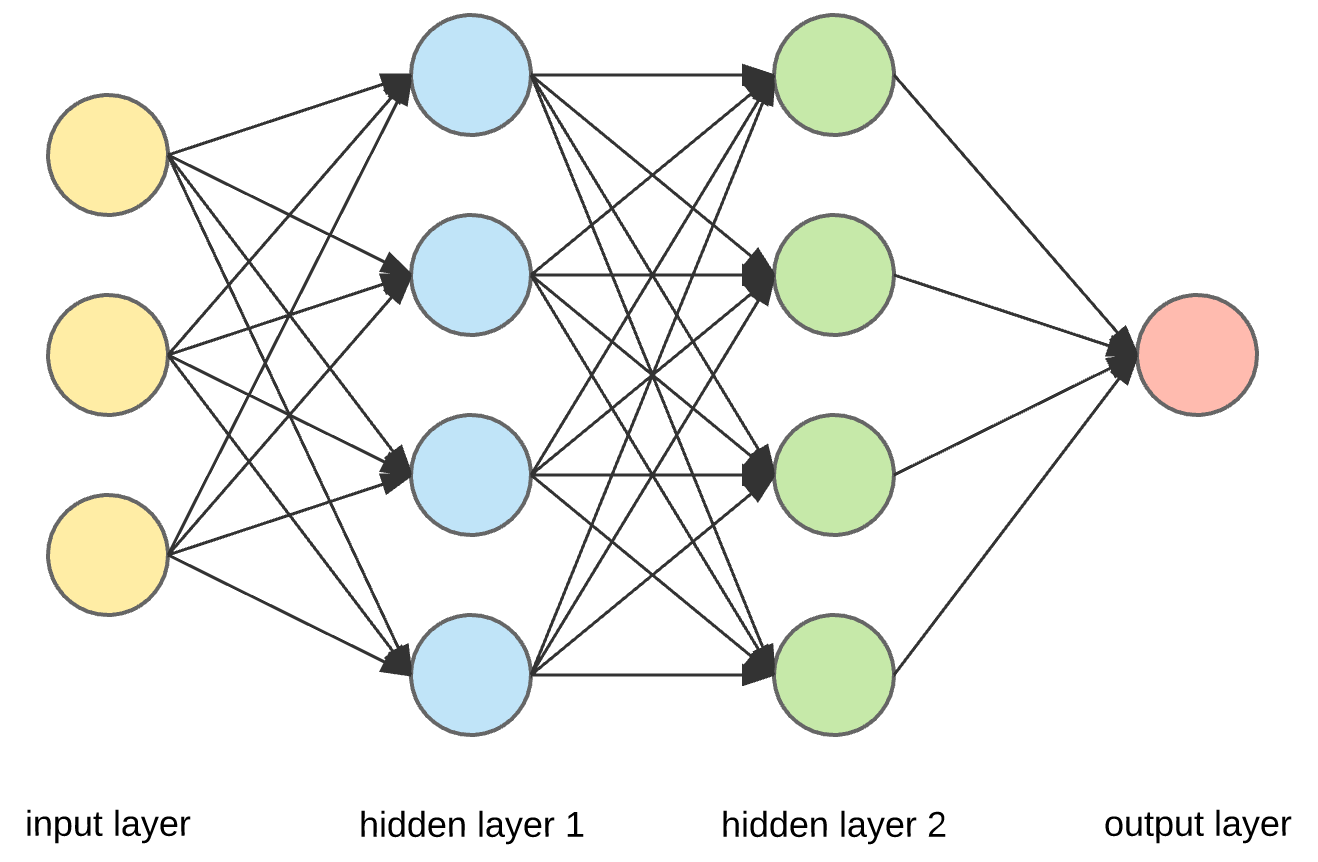
Your humble poster here once headed an Artificial Intelligence (AI) software project. One of my best programmers quit because of his frustration over complex nested conditionals (neural networks). The ultimate success of AI will depend on the ability to identify nodes in such networks as well as being able to deal with the almost infinite levels of conditional complexities.

It seems to this author that one of Trump’s great strengths as a policy maker is his ability to include in our country’s decision-making process an uncanny knack to identify previously ignored nodes in our neural network — unfair trade alliances, over regulation, Russian pipeline into Germany, NATO slackers, open borders, steel and aluminum being strategic US native industries, etc.

The jury is somewhat out on Trump’s ability to navigate these new expanded decision trees ... but he is still way, way ahead of our last four presidents.

Back to the subject at hand. Yes, quantum computers may someday be able to handle the huge number of complex conditionals involved in true AI. But, if a butterfly flapping it wings in Japan can cause a tornado in Alabama, I still have some doubts about the logistics of the data amassing project needed to account for all possible inputs into such an ultimate AI breakthrough.

How about it Elon?

Monday, March 26, 2018

Dismal Sciences


The world is full of scientists who have abandoned their craft ... and are shoving each other aside to get "liked" on Facebook or have their video go viral on YouTube. Science starts with a premise, collects reliable data, conducts experiments to validate, modify or disprove the premise, offers the data and experiment protocols to peers for reproducible validation or invalidation and, finally, publishes results using a non-political narrative. This is called the "scientific method."

Unfortunately, due to social, monetary and academic pressures, this scientific methodology has, in many instances, been short circuited ... or even abandoned. And, equally unfortunately, our naive public seldom notices ... not a recipe for greater enlightenment. May I offer some contemporary examples?

- Psychiatrists and psychologists are diagnosing our president with all kinds of mental maladies without having examined him in person. This goes against the basic tenets of these soft sciences.

- Climate scientists (97%?) who build computer models using "adjusted data" whose predictions do not even come close to transpiring ... yet who tenaciously hold by their debunked premises.

- There have been some pretty astounding predictions made by scientists and scientist wannabes about the future of artificial intelligence ... from the future of autonomous cars to cyborgs eventually taking over our lives. Many of these predictions seem pie-in-the-sky ... driven more by Internet grandstanding than by true science.

- Has anyone (besides my son) worried about the demands that might be put upon our electric grid if our nation went totally electric cars, trucks, buses and planes? Yet, Elon Musk is leading us by the nose into this brave new world. Either we have converted to nuclear power plants by then ... or the output of fossils fuel plants will rise dramatically. (And I will never fly by in a battery-powered plane.)

- Economists, the most dismal scientists of all, are quick to predict the results of changes in regulations, taxes and tariffs --- most of which are not based in any science but on political leanings.

Wednesday, November 09, 2016

Headlines


Shock -- and awesome: Movement of ordinary Americans stun global elite

Silicon sultans shit themselves ...

Trump shocks everyone with his performance among Hispanic and Black voters

3 states OK recreational pot

White House doesn't rule out pardoning Hillary Clinton

Wall Street traders chant 'lock her up' during Hillary's concession speech

Moveon organizes anti-Trump demonstrations around nation

Egyptian MP: Trump victory means 'dark days for Muslim Brotherhood'

Trump Jump: Stock market surges after upset victory ...

Artificial Intelligence predicts fourth election in a row ..

'Moving Sale' signs flood LA ...

Mick Jagger hints at playing Donald Trump's inauguration

Wednesday, June 01, 2016

MOOCs


Massive Open Online Courses (MOOCs) is a difficult subject because it is so relatively new. Clearly, if we are to heve any real productivity improvements in education, they will need to come from some type of automation. However, there are still those who disparage this on-line learning movement toward automating higher education primarily because it eliminates the classroom experience. For one such cynical argument, see: Dartblog Reader Response to President Phil Hanlon. If you actually want to see what Dartmouth's Prexy Hanlon said to elicit this response go to  Phil's Own Words: Education.

I myself have previously dealt with this MOOC subject in a previous blog post ... see: A Pedagogical Prediction. Having used some current software with students in on-line Internet courses during my recent gigs as a high school tutor, I can testify to its disappointingly poor quality ... thus I can understand the reader response referenced above. But believe me, when this technology of MOOC catches up to its potential, it will make what we are using today seem like a Model-T Ford relative to a BMW i8. In 5 or 10 years, the eventual MOOCs will meld the best of a 3-D classroom reconstruction with personal interaction with the artificial intelligence of a virtual professor.

Then, if student loans have not already sunk our economy, the next generations of our children will have it a lot easier (and cheaper) time of higher learning.

Tuesday, January 19, 2016

A Disconnect


The straight skinny coming out of the run-up to the World Economic Forum in Davos, Switzerland is that five million jobs will be lost in the developed world by 2020 due to the rapid advances being made in artificial intelligence and robotics ... see: Breitbart Story. Compound this with the vast migration of cheap labor and hanger-ons from the third world into the developed world ... this creates an employment disconnect that will be very difficult to reconcile both structurally and politically.

One of the reasons that China has had such dramatic economic growth over the last twenty-five years has been its vast supply of cheap and effective labor. Developed nations, in order to counter this economic advantage, have been (possibly somewhat unconsciously) opening their borders to the underdeveloped nations for immigrant labor ... with the result of reducing their national average personal incomes ... striving for wage and productivity parity with China.

Back to the Davos forecast ... a distinction needs to be made in the forces that are being pointed to for these expected employment reductions. Artificial intelligence mainly is of the mind ... allowing quicker and more effective decisions to be made. This does not necessarily remove the need for labor. (except when these decisions make robots or workers more effective.) It just improves the quality of generic decision making. However, robots in fact do replace physical laborers and thus will reduce actual employment (yet improve productivity.)

If in fact these Davos predictions are accurate, what does it mean for the American economy? Well, clearly the current administration will likely not back off its packing this country with immigrants. And if jobs are indeed drying up, this suggests an even higher percentage of these immigrants receiving government assistance ... with even fewer taxpayers funding these doles for the unemployed ... resulting unfortunately in much higher government deficits. Ouch!

There is only one possible solution in my mind ... start collecting taxes from the robots ...

Friday, June 05, 2015

AI


AI (Artificial Intelligence) is moving forward in leaps and bounds. There is a new product called Hound, a natural-language search engine for the Android smart phone, that can do remarkable things (if real). Watch a demonstration of its versatility in this YouTube Video. This product, developed by SoundHound Inc. (see: Corporate Website), is just bursting onto the market and is receiving considerable buzz. I first saw this demonstration on the reddit website and was quite impressed. A company I founded back in the 1990's, Occam Research Corp., developed a similar product (MUSE) ... but without the voice recognition and voice response. Although the above demonstration shows remarkable eclat, it does contain a few suspicious capabilities that deserve further investigation.

But, if real, this demonstration is a glimpse of what the future holds for AI ... a brave new world.

Sunday, February 15, 2015

Doomsday


Oxford University has spent considerable brainpower in assembling the probabilities of the world coming to an end … and has investigated twelve possible ways as outlined in a CNBC Story. These twelve catastrophic events ... with their Oxford-assigned probabilities [and my quick explanation in brackets for those of you who don’t do hyperlinks] are:

-        Unknown consequences – probability: 0.1% [“unc-uncs”]
-        Asteroid impact – probability: 0.00013%
-        Artificial intelligence – probability: 0-10%
-        Super volcano – probability: 0.00003%
-        Ecological collapse – probability: N/A [ala, Easter Island]
-        Bad global governance – probability: N/A [e.g., Obama rules]
-        Global system collapse – probability: N/A [12th Imam arrives]
-        Extreme climate change – probability: 0.01% [Al Gore is right]
-        Nuclear war – probability: 0.005%
-        Global pandemic – probability: 0.0001% [Ebola, etc.]
-        Synthetic biology – probability: 0.01% [frankenfoods, etc.]
-        Nanotechnology – probability: 0.01%

Now, for whatever reason, mankind is going through a period of considerable hand-wringing over such possible events (perhaps because we now have it so good) … but, as can be seen by the deductions and inductions of these Oxford dons, we should pay the most attention to the dweebs in Silicon Valley for our possible ultimate undoing. (I actually think that social media technology is well on its way.)