 |
| Photo by Albert Dros |
Showing posts with label Milky Way. Show all posts
Showing posts with label Milky Way. Show all posts
Wednesday, February 20, 2019


Sunday, September 18, 2016
Sapient Window (Update)

"Sapient window" is a term I have used before to describe the time period when intelligent beings on a planet have the knowledge base to realize the possibility of life existing elsewhere in the universe and the scientific wherewithal to search for it ... see: Sapient Window. In this referenced link I estimate that, here on Earth we are now in our sapient window ... having been so for about a hundred years or so.
Being in this window, we are pouring resources into attempting then to discover life on other planets ... and to look for them contacting us and, maybe, eventually contacting them ... a naturally appealing idea. The largest radio telescope ever built ... partly to this end ... has just been activated ... see: UK Mirror Story. So far this search has been to no avail using other means. As full of romantic agony this search entails, it is my contention that this quest is very likely to continue to be quixotic. (Stephen Hawking disagrees ... see: CNET Story.) And my sad conclusion is simply based on three indisputable facts:
1) The likelihood that our sapient window, even were it to last for another 13 thousand years, would line up with the sapient window on some other inhabited exo-planet ... just in our galaxy alone ... is vanishingly small ... given the enormous span since the beginning of time (the Big Bang?) ... I calculate the probability of such alignments at 0,0001% (see: Are We Alone?). Even if I am off by three orders of magnitude (because of things likely being back-end loaded), there is still only a one in a thousand chance of these sapient windows matching up.
2) The vast distances ... just in the galaxy in which our solar system exists, the Milky Way, let alone the Universe, are so large that the time delays imposed on any intelligent communications pretty much negate things ... even at the speed of light. We are talking about at least tens of thousands of years between any "Hello" and our excited response. This makes any meaningful communication pragmatically impossible.
3) it has been estimated that the energy required to send a receivable message of greeting over these vast interstellar distances could be equivalent to the energy output of our sun. I kind of doubt that this is realistically doable by all but a minuscule number of exo-planets with intelligent life, if any.
Thus, I again conclude that we are on a fool's errand with our attempt to wait for the phone to ring from another exo-planet ... and our possibly responding is even nuttier. The cost benefit analysis and actual science make no rational sense to this quest. I conclude that it is all just emotional pandering by scientists looking for more grant money.
Sunday, May 08, 2016
A Convenient Culprit
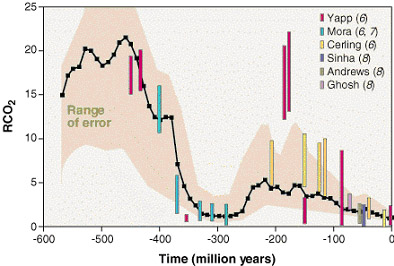
Let me try explaining things one more time.
The global-warming mania around the world exists because of ignorance ... ignorance of history and ignorance of science. Yes, according to recent satellite data (ground-based temperature measurements are now useless), our planet's temperature has increased a bit during our Industrial Age with the burning of fossil fuels. But this has only increased CO2 levels by at most 10 parts per million (+33%) over the last 150 years ... a mere bagatelle. And global temperatures have not increased at all for the last 17 years. This is embarrassingly known by scientists as "the pause" and is only discussed sotta voce. Politicians who claim that we are now hotter than ever are lying ... because they are conveniently basing these claims on ground-level measurements which are seriously biased by the recent effects of urbanization ... or, even worse, they are using altered raw data ... a scientific taboo.
My sincere hope is that, over the coming election year, politicians who wring their hands over global warming or climate change or climate extremes need to be asked the question I asked my party friend ... and, if they answer incorrectly, should be laughed off the stage. If they get it right, then should be asked what five other things might ever contribute to our planet's warming (like back when the Ice Age retreated)? And, if they can't name at least five other things (hints: solar cycles, slight changes in Earth's orbit, wiggles in the Earth's tilt, altering ocean currents, atmospheric particulates from vulcanization, methane level changes, water vapor changes, changes in our solar system's place in the Milky Way, tectonic plate shifts, any many more), they should again be ridiculed. If they can list five or more things, then they should be asked why carbon dioxide is then the primary suspect? This question can only be truthfully answered by the admission that it is the only convenient culprit that man might possibly control ... obviously a reducto absurdum and shows how unscientific the current climate science is ... at which point this pol's eyes should brighten and his/her mind be changed ... otherwise he/she is a charlatan.
Wouldn't that be a seminal moment?
My sincere hope is that, over the coming election year, politicians who wring their hands over global warming or climate change or climate extremes need to be asked the question I asked my party friend ... and, if they answer incorrectly, should be laughed off the stage. If they get it right, then should be asked what five other things might ever contribute to our planet's warming (like back when the Ice Age retreated)? And, if they can't name at least five other things (hints: solar cycles, slight changes in Earth's orbit, wiggles in the Earth's tilt, altering ocean currents, atmospheric particulates from vulcanization, methane level changes, water vapor changes, changes in our solar system's place in the Milky Way, tectonic plate shifts, any many more), they should again be ridiculed. If they can list five or more things, then they should be asked why carbon dioxide is then the primary suspect? This question can only be truthfully answered by the admission that it is the only convenient culprit that man might possibly control ... obviously a reducto absurdum and shows how unscientific the current climate science is ... at which point this pol's eyes should brighten and his/her mind be changed ... otherwise he/she is a charlatan.
Wouldn't that be a seminal moment?
Tuesday, July 15, 2014
Are We Alone?

NASA scientists, those champions of global warming, now have predicted that within 20 years we will have established that there is alien
life on some distant planet in the universe … see: CBS Story.
Actually this prediction is limited to our galaxy, the Milky Way, where NASA
estimates that there are “100 million worlds within the Milky Way galaxy [that]
are able to sustain complex life forms.” Who am I to argue with such considered
logic? But notice NASA does not use the term “intelligent life forms” nor do they
suggest that we might communicate with them … nor visit them … nor even have
them visit us. I have in the past done some rudimentary analysis on this very subject
(see: Cosmic Silence ) which I would like to apply to NASA’s newer speculations.
Let us start with some facts about the Milky Way … it has
about 200 billion stars, is about 13.6 billion years old and is 120,000 light
years across. Our solar system is about
26,000 light years from its center … or roughly half way out from its center …
see: Universe Today. I would now like to slice this prediction two
ways … by time and space.
First let’s look at time horizons: The Milky Way is about 13.6 billion years old and our earth
is about 1/10 of that age ... all back-end loaded. I would imagine that
many of these other NASA theorized exo-planets are either yet to be ... or
have been burnt to a crisp when their suns became red giants. So, if
NASA did not account for these life-limiting events, automatically these 100
million of stars with habitable exo-planets is reduced by some large factor. But, you know what, I’ll here give NASA the
benefit of the doubt and keep their number at 100 million.
From my previous analysis I opine that “sapient life on our earth has existed for perhaps only a million years ... or 1/13,000 of this earth's existence and scientific advancement sufficient to understand our time and place in the universe has existed for, at most, 100 years ... or 1/130,000,000 of this planets existence. Let us (optimistically) imagine that this enlightenment age on earth will last for another 13,000 years. This would result in a sapient window for our planet to be about 1/1,000,000 (one-millionth) of its total existence ... which fraction I suggest should then apply to other exo-planets.” So this logic would reduce NASA’s estimate to only 100 exo-planets in the Milky Way with current intelligent life forms (within their sapient windows) … out of NASA’s 100 million estimated exo-planets with any form of complex life. But still encouraging … no?
But next we
still have to deal with immense distances. Simple geometry says that the
average distance to any other exo-planet in our Milky Way (our sun’s nearest
star, Proxima Centauri, a red dwarf, being 4.22 light years and the furthest,
being about 94,000 light years) is almost 47,000 light years … clearly such
distances preclude much intra-galactic travel … even if one could travel at the
speed of light (which, according to Einstein is impossible.) It also eliminates much possible contemporary
communications … even with electro-magnetic waves traveling at near to the speed
of light … unless such distant exo-planet’s sapient window is within the last
47,000 years. And, even at that, the turn-around time to acknowledge a “hello”
would not reach them until the year 49,014 AD … at which point they might have
forgotten that they sent the message to begin with.
So, let us make
things easier and estimate that we will only hope for intelligent life on those
exo-planets that lie within 100 light years of our solar system (assumedly all
within our Milky Way). It is estimated that the number of stars that are within
this arc is some 15,000 (see: Imagine) ... but lets make it simpler by upping it to 20,000. This is 1/10,000,000 (one ten millionth) of
the stars in the Milky Way … which proportion needs then to be applied to that
100 exo-planets estimate in the whole Milky Way with possible intelligent life
(from paragraph four above). This says to
me that the chances that there is an exo-planet within 100 light years of Earth
with intelligent life at 1 in 100,000 (=100/10,000,000).
Clearly not
very possible … yet we are spending billions of dollars to get these ETs to phone home. We Earthlings (and NASA) clearly are romantic souls ...
Afterward: This analysis (like my other blog referenced above) does not show that there is not any life nor intelligent life anywhere in the Milky Way. In fact, if one's vista was to include the entire universe, I do believe that it is quite likely that there is such life ... and even intelligent life ... out there. But what is does conclude is that it is very, very unlikely for us ever to have any conclusive evidence that intelligent life exists or did exist elsewhere. The time and space constraints are just too vast.
Afterward: This analysis (like my other blog referenced above) does not show that there is not any life nor intelligent life anywhere in the Milky Way. In fact, if one's vista was to include the entire universe, I do believe that it is quite likely that there is such life ... and even intelligent life ... out there. But what is does conclude is that it is very, very unlikely for us ever to have any conclusive evidence that intelligent life exists or did exist elsewhere. The time and space constraints are just too vast.
Friday, August 30, 2013
reddit Gallery III
See reddit Pics for sources. Click on picture to enlarge it. Enjoy!
 |
| Giant's Causeway, Ireland |
 |
| Kamchatka |
 |
| Milky Way |
 |
| Super Cell |
 |
| Osmium Cluster |
Friday, September 21, 2012
Balderdash!

In the local Scott Brown/Elizabeth Warren debate last night (Massachusetts Senate race), Scott said that he thought that global warming was real, but that he wasn't sure to what degree that mankind was responsible. Can this be? Yes, I suppose that Scott's justifiably timid premise might be based upon the recent shrinking of the Arctic polar ice cap ... see: AP Story). However, what is less frequently mentioned by the cult of greenies is that the ice cap in Antarctica is growing. In fact it recently reach its largest size in 33 years! (See: Forbes Story).
Now I am sure that the Northern Hemisphere produces more carbon dioxide than the Southern Hemisphere (particularly since China is building about one coal-powered power plant per week), but I am also sure that the Southern Hemisphere produces more carbon dioxide than in past years. Yet, its ice cap is growing! Ergo, this means that the dynamics of global warming and global cooling is far more complicated than our covey of animated climate scientists are willing to admit.
I have previously stated in this blog and my Junkier Science blog that our earth's climate is clearly affected by numerous things, minute changes in the Earth's tilt, alterations in solar radiation levels, the dynamics of ocean current shifts, increased/decreased levels of atmospheric particulates from things like volcanoes, atmosphere chemistry changes (including CO2), and maybe even our Solar System's shifting position in the Milky Way. Of all these independent variables, the only one that man might have any control over is CO2 levels. To me, this seems to be too convenient a solution to our angst over what may (or may not) be happening to our climate. One time a surgeon told me that, since he was good a wielding a hammer, every health problem looked to him like a nail.
I sincerely think that far too many scientists see CO2 as a climate-change "nail" because it is the only dial that mankind might twist to fix things. Therefore, data is fudged and simulation models are "adjusted" so as to prove this singular point. If these simulation models were multivariate instead of single variant, I might be more easily convinced. But they are not, and, until they are ... BALDERDASH!
Subscribe to:
Posts (Atom)